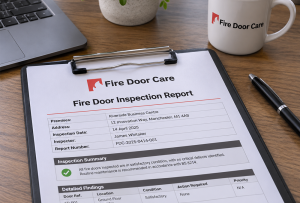
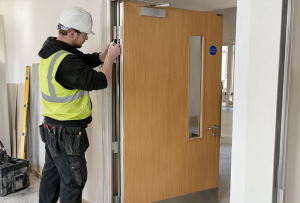
When it comes to fire safety in buildings, fire doors are your silent sentinels. They aren’t just heavy slabs of wood or metal; they are engineered life-safety devices. However, navigating the British Standards that govern them can feel like wandering through a maze of technical jargon.
If you are a building manager, architect, or contractor, understanding BS 476 and BS 8214 is non-negotiable. Here is a breakdown of what these standards mean and how they work together to keep occupants safe.
What is BS 476?
The BS 476 series is the bedrock of fire testing in the UK. Specifically, Parts 20 and 22 are the most critical for fire doors. This standard dictates how a door must behave when subjected to extreme heat.
How BS 476 Testing Works
During a BS 476 test, a full-scale door assembly is built into a wall and placed in a furnace. The door is subjected to temperatures that can exceed 900°C to simulate a real-world blaze.
- Integrity (E): Does the door stay in its frame without letting flames or hot gases through?
- Insulation (I): How well does the door prevent the non-fire side from getting too hot?
Common Fire Door Ratings
You’ll see results expressed in minutes, which translate to the fire door ratings we use daily:
- FD30: 30 minutes of fire resistance.
- FD60: 60 minutes of fire resistance.
- FD90/FD120: Used in high-risk areas like basement boiler rooms or commercial high-rises.
You can learn more about fire door ratings in our blog post The Ultimate Guide to UK Fire Door Ratings.
What is BS 8214?
While BS 476 tells you if a door can work, BS 8214 tells you how to make sure it will work in a real building. Updated significantly in 2016, BS 8214 is the “how-to” guide for timber-based fire doors.
BS 8214 covers the entire lifecycle of the door, including:
- Specification: Selecting the right door for the right environment.
- Installation: Ensuring the gap between the door and the frame (usually 3mm–4mm) is precise.
- Maintenance: How often to check hinges, closers, and intumescent seals.
- Marking: Ensuring every door has a plug or label identifying its rating and manufacturer.
Important Note: A door tested to BS 476 can be rendered completely useless if it isn’t installed according to the guidelines in BS 8214. If the gap is too wide, smoke and fire will simply bypass the door.
The Role of Intumescent Seals
Both standards place heavy emphasis on seals. Under the heat of a fire, these strips (usually hidden in the door edge or frame) undergo a chemical reaction that causes them to expand significantly.
This expansion “plugs” the gaps around the door, preventing the passage of fire. If the door also needs to stop smoke (indicated by an “S” rating, e.g. FD30S), it must include a cold smoke seal, which looks like a brush or a rubber fin.
You can learn more about intumescent seals in our blog post A Guide to Fire Door Intumescent Strips and Smoke Seals.
BS 476 vs EN 1634-1
It is worth noting that while BS 476 is the traditional British standard, it exists alongside the European standard, BS EN 1634-1.
| Feature | BS 476 | BS EN 1634-1 |
| Pressure | Neutral/Low Pressure | Positive Pressure (Harder to Pass) |
| Thermocouples | Placed Differently | More Rigorous Heat Monitoring |
| Status | Widley Used in The UK | Required for CE/UKCA Marking |
While both are currently accepted in the UK, the industry is gradually shifting toward the EN standards for more rigorous consistency.
Conclusion
Think of it this way: BS 476 proves the door is a hero, but BS 8214 ensures the hero is standing in the right place, wearing the right armour, and ready for the fight. You cannot have a compliant building with one but not the other.
Why Choose Fire Door Care?
At Fire Door Care, we specialize in the full lifecycle of fire door safety. From initial inspections and identifying hardware failures to the precision installation of fire-rated components, we ensure your property meets all current safety standards.
Our certified team delivers high-quality solutions to enhance fire resistance, prevent smoke spread, and safeguard lives. Whether you need a new fire door, routine inspections, or urgent repairs, we provide reliable and cost-effective services tailored to your needs.
- Safety First: We prioritise protecting lives and properties by ensuring every fire door meets the highest safety standards.
- Uncompromising Quality: Our expert team delivers precision craftsmanship and reliable solutions for long-lasting fire protection.
- Integrity You Can Trust: We are committed to honest, transparent, and dependable service at every step of the process.
- Customer Focused: Your safety is our mission. We tailor every inspection, repair, and installation to your unique needs.
If you would like to find out more about our fire door services, or would like help, advice or a quote please feel free to call us on 0203 488 5923 or send us a message here.