Fire Door Inspection Reports: What Should They Include?
Fire doors are a vital part of any building’s passive fire protection system. Designed to slow the spread of fire

Fire doors play a critical role in slowing the spread of fire, protecting escape routes, and giving occupants time to evacuate. However, damaged or poorly maintained fire doors can fail in an emergency, putting lives and property at risk.
UK fire safety regulations, including the Regulatory Reform (Fire Safety) Order 2005 (RRO), require Responsible Persons (such as building owners, employers, or landlords) to ensure that fire doors are inspected and maintained regularly. Non-compliance can result in hefty fines, legal penalties, and increased liability.
Common issues uncovered during inspections include:
Identifying and addressing these issues through professional inspections is key to maintaining compliance and safeguarding building occupants.
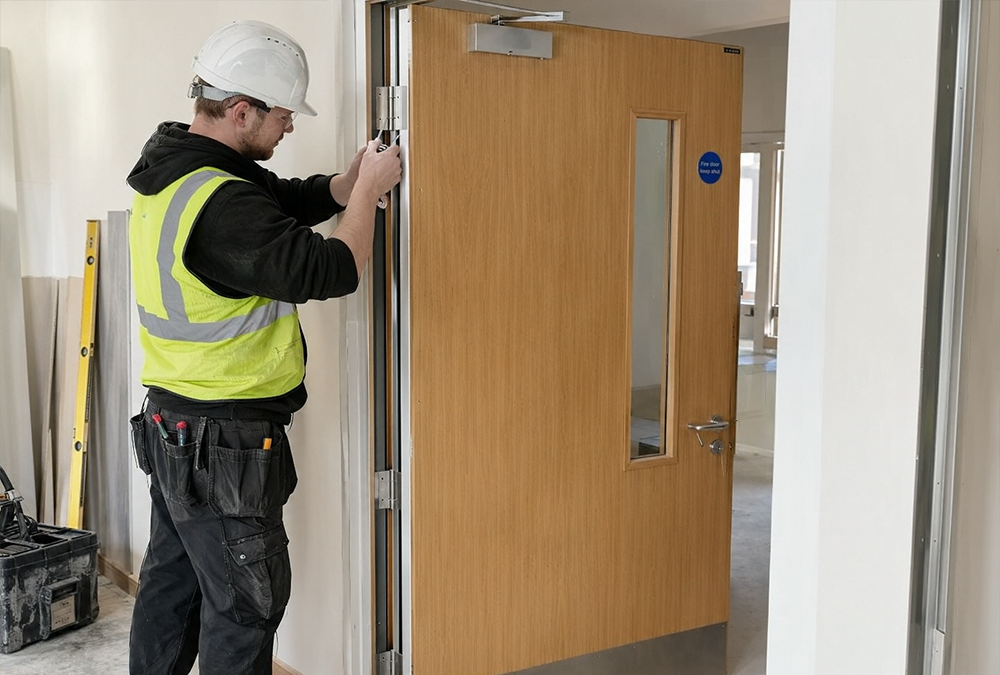
Our fire door inspection services include a thorough assessment of all aspects of your fire doors, ensuring they meet British Standards (BS 476 Part 22 or BS EN 1634-1). Here’s what we inspect:
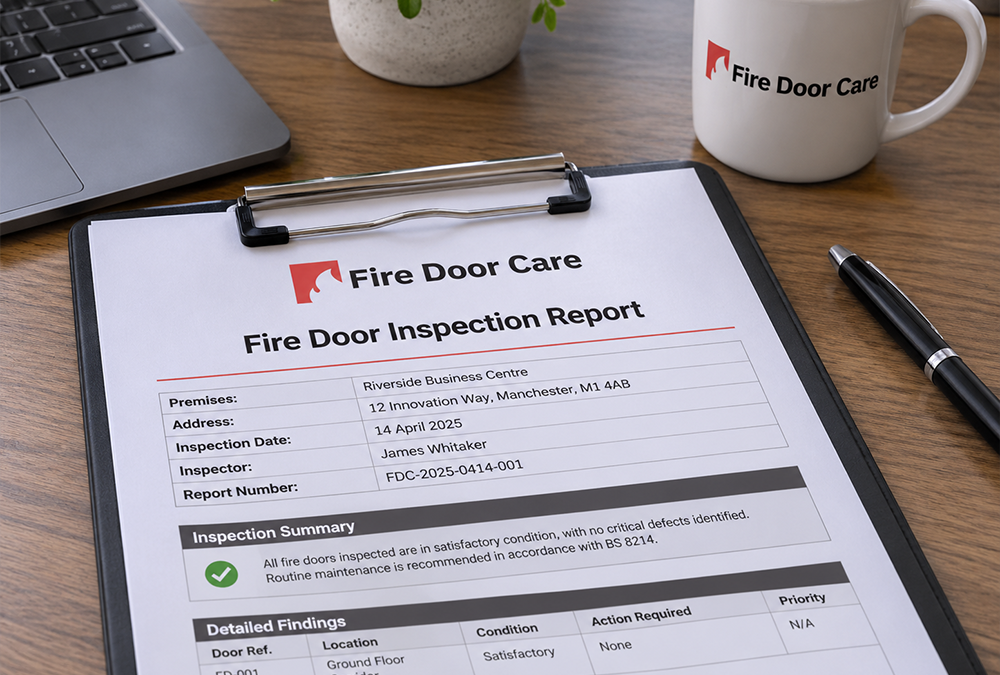
Following the inspection, we provide a detailed report outlining the condition of each fire door, any defects identified, and recommended actions for repair or replacement.
The frequency of fire door inspections depends on the building type, usage, and fire risk assessment. As a guideline:
Regular inspections not only keep your fire doors in optimal condition but also demonstrate compliance with legal requirements.
At Fire Door Care, we are committed to providing reliable, expert fire door inspection services to help you stay safe and compliant. Here’s why we’re the trusted choice for businesses and landlords across the UK.
Our team is fully trained in fire door regulations and British Standards, ensuring a thorough and accurate assessment every time.
We provide clear, actionable reports that include photographic evidence and prioritised recommendations.
We work with you to develop an inspection plan that meets your building’s specific needs and risk profile.
From inspections to repairs, we offer a full suite of fire door services to keep your building safe and compliant.
A thorough inspection assesses the overall structural integrity and functionality of the entire door system. It checks for warping or damage to the door leaf, verifies that the frame is securely fixed, measures the gaps on all sides, inspects the condition of hinges and latching hardware, tests that the self-closer shuts the door fully, and ensures that intumescent and smoke seals are intact and continuous.
No, routine quarterly and annual checks do not strictly require an expensive external contractor. Government guidelines state that these routine checks are simple visual assessments that can be carried out in-house by a “competent person,” such as a trained building manager, caretaker, or landlord. However, if complex faults are identified, a specialist should be brought in to handle the repairs.
Open the door fully and let it go to ensure it closes and latches securely into the frame without sticking. Next, open the door slightly to about 15 degrees (just a couple of inches) and release it again. The door must still have enough momentum to overcome the latch and close fully on its own. If it fails to latch from this short distance, the closer needs adjustment or replacement.
Inspectors use a physical gap gauge or a graduated card to measure the clearance between the door leaf and the frame at the top and sides. This gap must consistently measure between 2mm and 4mm. The bottom gap is also checked to ensure it does not exceed 10mm, or 3mm if a smoke seal is present.
You must check that the strips are continuous, fully intact, and securely glued into the groove of either the door leaf or the frame. Look for signs of peeling, cracking, or missing sections. If the door has brush-like or rubber smoke seals, ensure they are not crushed, torn, painted over, or worn down, as this prevents them from stopping toxic cold smoke.
Not automatically. Under UK government guidance updated in late 2025, functionality takes priority over paperwork. If an older notional timber door lacks a physical label but is structurally sound, sits flat in its frame, has the correct gaps, and closes perfectly on its own, it is generally deemed compliant and does not need to be replaced simply because it lacks a modern certificate.
For residential blocks over 11 metres in height, the Responsible Person must use “best endeavors” to inspect all individual flat entrance doors at least once every 12 months. This requires arranging access with residents in advance to check both sides of the door, ensuring the self-closer is active and that residents have not tampered with or removed the closing mechanism.
Failing to inspect and maintain fire doors is a criminal offense under the Regulatory Reform (Fire Safety) Order. If a fire risk assessment or local fire authority audit finds neglected fire doors, they can issue enforcement or prohibition notices. Severe or persistent non-compliance that puts lives at risk can lead to prosecution, resulting in unlimited fines and up to two years’ imprisonment.
Yes, keeping detailed records is a legal necessity under modern UK safety legislation. For higher-risk buildings over 18 metres, the Building Safety Act requires fire door inspections to be logged as part of the digital “Golden Thread” of safety information. For all other properties, maintaining a robust paper or digital log of dates, findings, and repairs is essential to prove compliance during official safety audits.
Hardware is a common point of failure. Inspectors will check that there are at least three hinges, that all screws are present and tight, and that there is no dark, oily residue (slidage) indicating internal hinge wear. They will also verify that locks, latches, and handles operate smoothly and that no non-fire-rated hardware has been retrofitted, which could melt and create a path for fire.
Fire doors are a vital part of any building’s passive fire protection system. Designed to slow the spread of fire

Fire doors are an essential part of a commercial building’s passive fire protection system, helping to prevent the spread of
Fire doors play an essential role in protecting buildings and their occupants from the spread of fire and smoke. Whether