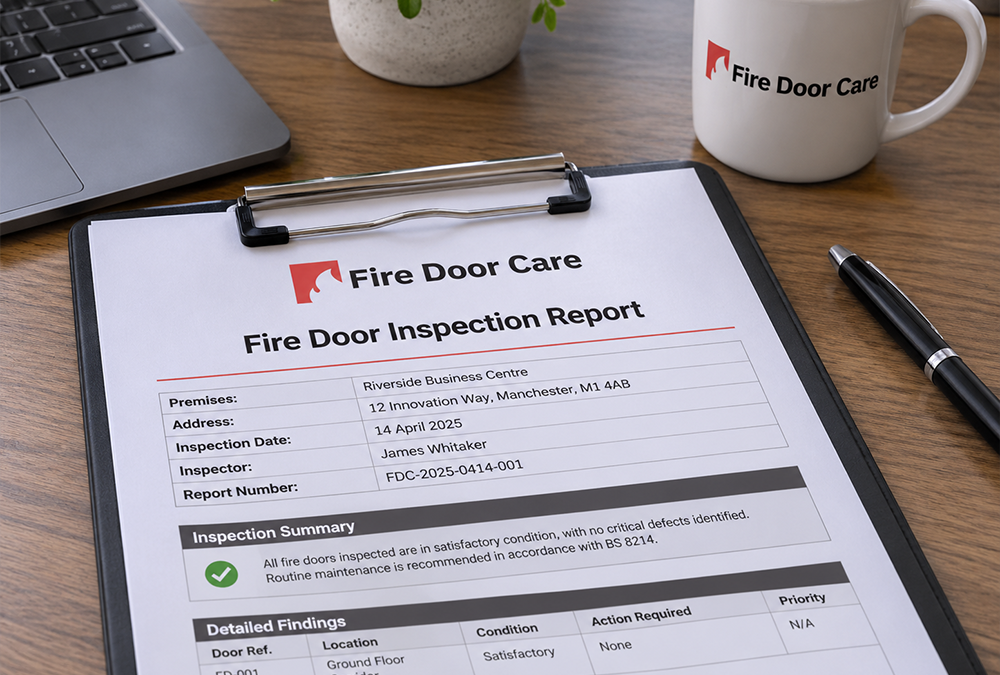
Fire Door Inspection Reports: What Should They Include?
Fire doors are a vital part of any building’s passive fire protection system. Designed to slow the spread of fire

A fire door is only as effective as its installation. Even a high-quality fire door can fail if it’s not installed correctly, leaving your building vulnerable to fire spread. Here’s why proper installation is crucial:
Fire doors are required in various sectors and building types, including:
At Fire Door Care, we offer comprehensive fire door installation services tailored to your building’s needs. Our team of certified professionals ensures your fire doors are installed correctly and meet all UK safety standards.
We start by conducting a thorough assessment of your building’s layout, fire safety plan, and risk factors. This allows us to identify the specific locations and types of fire doors required.
We supply and install fire doors that meet British Standards (BS 476 Part 22 or BS EN 1634-1) and are customised to your building’s specifications. This includes:
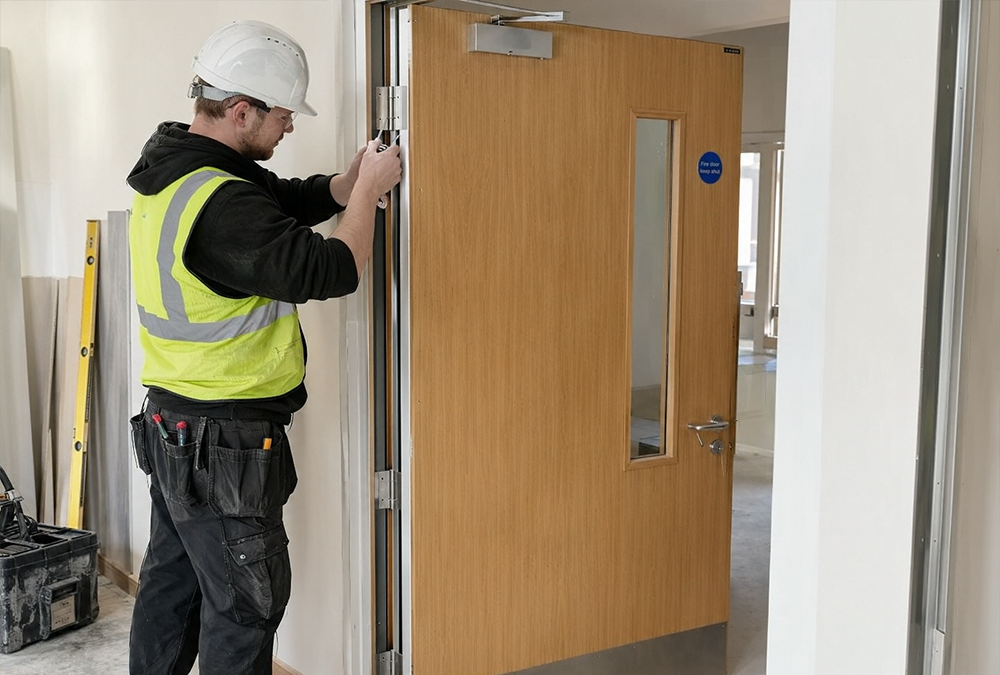
Our certified installers ensure each door is fitted with precision, including:
We provide all necessary documentation to confirm that your fire doors meet legal standards. This includes certificates of compliance for your fire safety records.
Our team is fully trained and experienced in fire door installation, ensuring compliance with all UK regulations.
We use only certified fire doors and components to guarantee safety and durability.
We design and install fire doors to suit your building’s specific needs, whether it’s a commercial property, residential block, or public facility.
From initial consultation to final certification, we handle every aspect of fire door installation.
A fire door set is a complete, fully matched system pre-assembled in a factory. It includes the door leaf, frame, hinges, seals, and ironmongery, all certified to work together. Installing a pre-assembled door set minimises on-site installation errors, speeds up the fitting process, and guarantees that all components are fully compatible and compliant.
No, you cannot simply hang a new fire door leaf in a standard, non-certified frame. A fire door must be installed into a compatible, fire-rated frame that matches the door leaf’s original test evidence. Standard frames are often too thin or made of softwoods that cannot withstand the structural stresses and temperatures of a fire.
The structural gap between the newly installed door frame and the wall must be kept as tight as possible, typically under 10mm. This gap must be filled completely with an approved, tested fire-stopping material, such as specialist fire-rated foam or intumescent acrylic sealant, to prevent fire and toxic gas from bypassing the frame.
Yes, a fire door must be hung with at least three robust, fire-rated hinges that have a melting point of over 800oC(usually grade 11 to 13 steel). Underneath the hinge blades, you must install pre-cut intumescent bedding pads to protect the timber frame from heat transfer and prevent the hinges from burning out of the wood.
No, you should never cut a hole and install glazing into a fire door on-site unless the door manufacturer explicitly permits it in their certification and you use their precise glazing kit. Cutting into a fire door leaf on-site without verified manufacturer data destroys its structural core, instantly voiding its safety certification.
The trimming allowance is strictly determined by the manufacturer and is usually limited to a maximum of 3mm to 5mm from the bottom edge only. Trimming the top or sides of the door is generally prohibited, as doing so will destroy the protective hardwood lipping and potentially cut through the door’s internal certification plugs.
The self-closer is what ensures the fire door actually does its job when the alarm sounds. The closer must be a fire-rated, UKCA-marked device that is powerful enough to overcome the latch resistance and fully close the door from any angle. It must be installed exactly to the manufacturer’s templates to avoid putting uneven stress on the door.
While there is no direct legal requirement for installers to hold a specific government license, UK law mandates that installations must be carried out by a “competent person.” Utilising installers certified under schemes like LPCB, FIRAS or BM TRADA Q-Mark is the industry gold standard and protects the building’s “Responsible Person” from significant legal liability.
Immediately after installation, you must verify that the door closes and latches smoothly from all angles, that the gaps around the top and sides are consistently between 2mm and 4mm, and that the threshold gap does not exceed 10mm. You must also ensure that all intumescent seals are in place and that the door operates without binding or scraping.
Upon completion, the installer must hand over a comprehensive compliance pack. This must include the manufacturer’s fire test data, the third-party certification certificates, an installation checklist confirming all components used are fire-rated, and maintenance instructions. This documentation is a vital part of the building’s legally required “Golden Thread” of safety information.
Fire doors are more than just a legal requirement—they’re a critical safety feature that protects lives and property. Don’t take chances with fire safety. At Fire Door Care, we deliver professional fire door installations you can trust.
Contact Us Today to schedule a consultation or request a free quote. Let us help you ensure your building is safe, compliant, and ready to withstand any fire emergency.
Submit an enquiry or call us on: 0203 488 5923.
Fire doors are a vital part of any building’s passive fire protection system. Designed to slow the spread of fire

Fire doors are an essential part of a commercial building’s passive fire protection system, helping to prevent the spread of
Fire doors play an essential role in protecting buildings and their occupants from the spread of fire and smoke. Whether