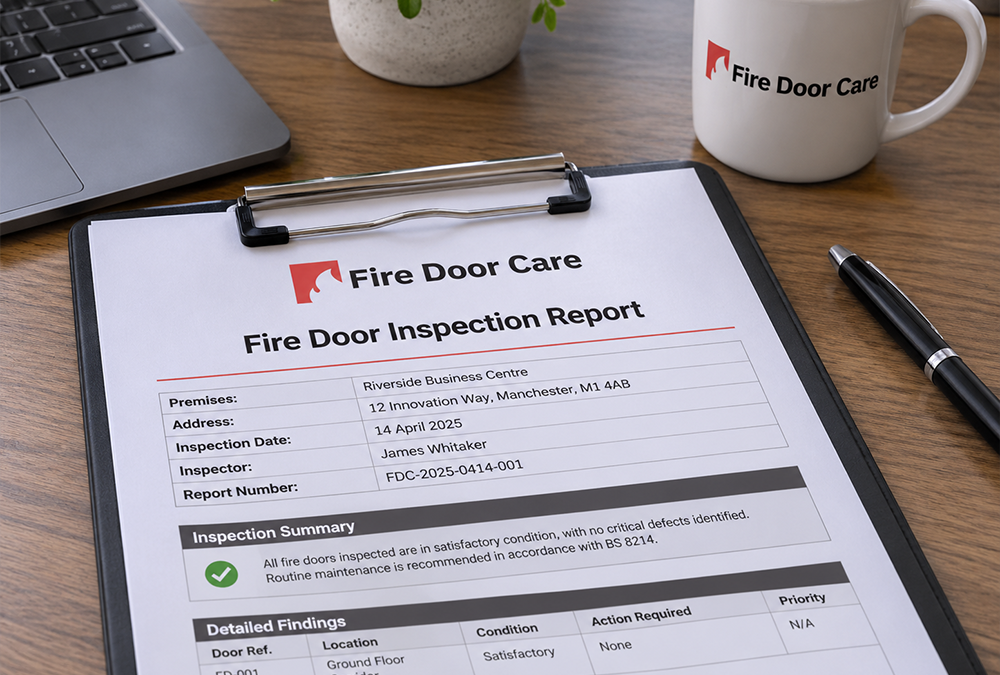
Fire Door Inspection Reports: What Should They Include?
Fire doors are a vital part of any building’s passive fire protection system. Designed to slow the spread of fire

Fire doors are designed to slow the spread of fire and smoke, giving people valuable time to evacuate and helping emergency services contain the fire. However, damaged or poorly maintained fire doors fail to meet legal standards and jeopardise safety. Some common issues requiring repair include:
Ignoring these issues not only puts lives at risk but can also lead to hefty fines or legal action under the Regulatory Reform (Fire Safety) Order 2005 (RRO).
At Fire Door Care, we offer a full range of fire door repair services to ensure your doors are fully functional and compliant with UK regulations. Here’s what we can do for you:
1. Comprehensive Assessments
Our repair process begins with a thorough inspection of your fire doors to identify defects and assess their condition. We provide a detailed report with clear recommendations for repairs.
2. Expert Repairs
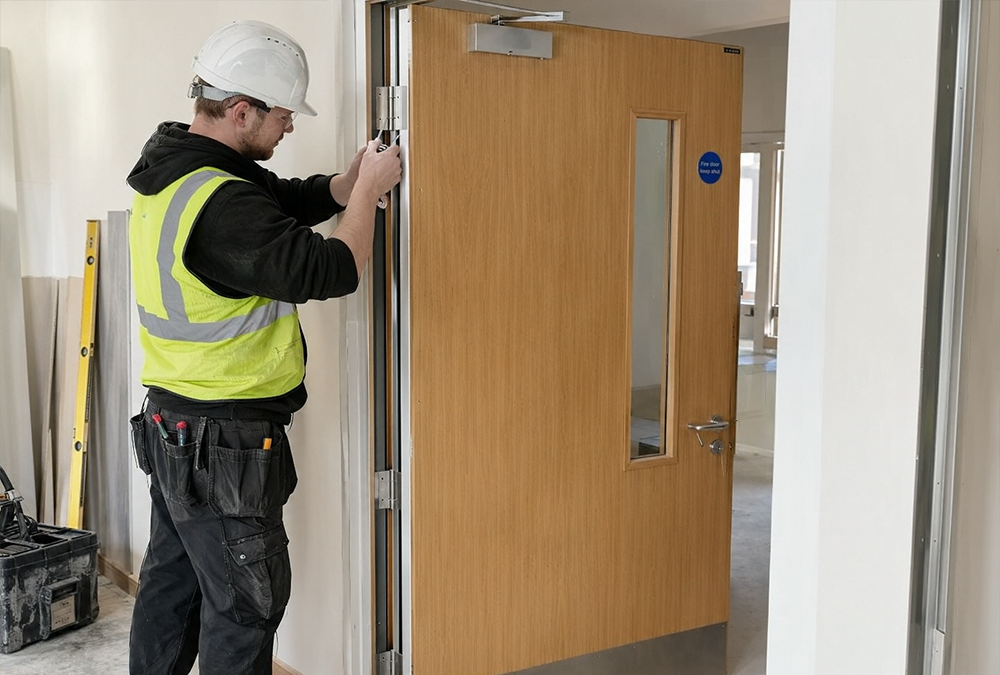
Our certified technicians specialise in repairing all components of a fire door, including:
3. High-Quality Materials
We use only high-quality, certified components and materials to ensure your fire doors meet British Standards (BS 476 Part 22 or BS EN 1634-1).
4. Compliance Assurance
Once repairs are complete, we perform rigorous testing to confirm your fire doors are compliant and provide documentation for your fire safety records. We are LPCB certified meaning you can have total confidence you are compliant.
Our team is fully trained in fire door regulations and British Standards, ensuring a thorough and accurate assessment every time.
We handle all types of fire door repairs, from minor adjustments to complete refurbishments.
We understand the urgency of fire safety and offer prompt service to minimise downtime.
We work with you to minimise disruption to your operations and provide ongoing support.
A fire door repair refers to any maintenance action taken to restore a damaged or non-compliant door assembly back to its original fire-certified state. This includes replacing damaged intumescent seals, adjusting or replacing faulty self-closing devices, tightening or renewing fire-rated hinges, and correcting the gaps around the door frame to ensure it seals perfectly during a fire.
No, you cannot use standard hardware-store wood fillers or non-protective timber for repairs. Any material used to patch or repair a fire door leaf must be explicitly approved by the door manufacturer’s original test evidence or “Field of Application” (FoA) report. Using unauthorised materials will completely void the door’s third-party safety certification and compromise its fire rating.
Under the strict “Complete System” concept reinforced by BS 8214:2026, a replacement closer cannot just be any off-the-shelf model. It must be fire-rated, carry a UKCA mark, and be explicitly listed as compatible with that specific door type and fire duration (e.g., FD30 or FD60) in the manufacturer’s technical data.
Damaged, peeling, or heavily painted intumescent strips must be completely removed, and the groove cleaned thoroughly before installing exact replacements. The new strips must match the original width, depth, and specification (such as a combined brush smoke seal) to ensure they expand correctly under intense heat to seal the room.
Yes, but only within strict margins. Most certified fire doors only allow a maximum trim allowance of 3mm to 5mm from the bottom edge, and zero trimming from the top or sides where the certification plugs are located. Exceeding the manufacturer’s stated trim allowance destroys the internal structural core and voids the certification.
You can paint the faces and edges of the timber door leaf using standard decorative paint, but you must never paint over the intumescent strips or smoke seals. Paint prevents the chemical strips from expanding under heat and glues smoke brushes together, meaning any painted-over seals must be completely replaced during maintenance.
A loose frame is a major structural failure that allows fire to bypass the door entirely. Maintenance teams must pack the gaps between the frame and the structural wall with an approved, fully fire-tested backfilling material (such as specialist fire-rated foam or acrylic sealant) and secure it with tested fire-resisting fixings.
While the law does not require installers to hold a specific government license, all repairs must be executed by a “competent person” with appropriate training, knowledge, and experience. To protect your business from legal liability, it is best practice to hire third-party accredited contractors who can provide written evidence of compatibility for every part they use.
No, you can maintain and replace individual ironmongery components without buying a new door, provided the new parts are identical in specification and fire performance to the original hardware. For example, replacement hinges must be fire-rated and fitted with the correct intumescent bedding pads behind the hinge blades if specified by the manufacturer.
Building managers must log every repair in a digital or paper compliance file to maintain the statutory “Golden Thread” of safety information. Your maintenance records must clearly state the date of the repair, the specific defects resolved, the exact part numbers used, and the verified test data proving those parts are compatible with the door system.
Fire doors are a vital part of any building’s passive fire protection system. Designed to slow the spread of fire

Fire doors are an essential part of a commercial building’s passive fire protection system, helping to prevent the spread of
Fire doors play an essential role in protecting buildings and their occupants from the spread of fire and smoke. Whether