Fire doors are far more than just heavy slabs of wood or metal; they are life-saving engineered systems. Yet, in the world of facility management, they are often treated with a “fix it when it breaks” mentality. This reactive approach isn’t just a safety risk, it is a financial drain.
Building a business case for proactive fire door maintenance requires shifting the conversation from cost to value and risk mitigation. Here is how to distinguish between the two approaches and why maintenance always wins the ROI battle.
The Cost of Emergency Fire Door Repairs and Reactive Maintenance
When a fire door fails an inspection or, worse, stops functioning during daily use, the resulting “emergency repair” comes with a hidden price tag that far exceeds the invoice from the technician.
- Premium Labour Rates: Emergency call-outs often trigger “urgent” or “out-of-hours” fees, sometimes doubling or tripling the standard hourly rate.
- Operational Downtime: A compromised fire door in a corridor or stairwell can lead to the temporary closure of entire building zones to remain compliant with fire safety codes.
- Limited Parts Availability: In an emergency, you are at the mercy of whatever stock is on the van. This often leads to temporary, non-matching, or overpriced fixes just to get the door “functional” again.
- Legal and Insurance Exposure: Operating a building with known fire door defects significantly increases liability. In the event of an incident, “we were waiting for it to break” is not a valid legal defense.
Why Proactive Fire Door Maintenance Extends Asset Lifespan and Saves Capital
Proactive maintenance is the practice of inspecting and servicing doors on a scheduled basis (typically every 6 to 12 months) to catch minor wear before it becomes a structural failure. By investing in a planned preventative maintenance (PPM) schedule, businesses can realize several key benefits:
Predictable Budgeting
Maintenance allows you to forecast spending. Instead of an unexpected £2,000 repair in the middle of Q4, you have a fixed annual fee that covers inspections and minor adjustments like tightening hinges or replacing intumescent strips and smoke seals.
Component Longevity
A fire door is a system of moving parts. If a door self-closer is slightly out of alignment, it puts undue stress on the hinges. Over time, this warps the door leaf itself. Regular lubrication and adjustment prevent this “domino effect” of damage.
Compliance Peace of Mind
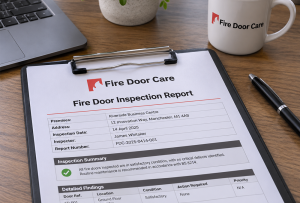
Regular maintenance logs provide a golden thread of information. This documentation proves to fire marshals, inspectors, and insurers that you are meeting your obligations under the Regulatory Reform (Fire Safety) Order 2005.
The Difference Between Fire Door Maintenance vs. Repair
It is helpful to understand exactly what happens during these two different scenarios to see where the value lies.
During a Maintenance Visit
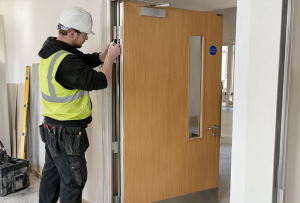
A technician checks the gaps (which must usually be between 2mm and 4mm), inspects the intumescent strips for damage, ensures the self-closing mechanism brings the door firmly into the latch from any angle, and checks that the glazing is secure. These are “tweak and tune” tasks that keep the door in peak condition.
During an Emergency Repair
The technician is often dealing with a “catastrophic” failure. This might include a snapped overhead closer, a dropped door that is scraping the floor and damaging the fire-rated frame, or a shattered vision panel. At this stage, you aren’t maintaining an asset; you are performing surgery on it.
The Business Case For a Fixed Fee Approach to Fire Door Maintenance
To convince stakeholders, the business case must be framed in terms of risk vs. reward.
- The Safety Argument: Maintaining a fire door ensures it will perform its primary function,; containing smoke and flames for 30 or 60 minutes and allowing occupants to escape. This is the ultimate “non-negotiable” for any board of directors.
- The Financial Argument: Data suggests that the cost of three years of proactive maintenance is often less than the cost of a single major emergency replacement of a bespoke fire door set.
- The Reputation Argument: For sectors like healthcare, hotels, or high-end residential, visible signs of “broken” safety equipment (like taped-up doors or missing seals) erode trust with clients and residents.
Conclusion: Shifting from Reactive to Proactive Fire Safety
Emergency repairs are a sign of a failing facility strategy. While you can never eliminate the possibility of a hardware failure, you can drastically reduce the frequency and severity of these events through a dedicated maintenance program.
By choosing maintenance over repairs, you aren’t just “spending money on doors”, you are protecting your people, your property, and your bottom line.
Why Choose Fire Door Care?
Fire Door Care are LPCB certified meaning your can have total confidence in our work and your compliance. We specialize in the full lifecycle of fire door safety. From initial inspections and identifying hardware failures to the precision installation of fire-rated components, we ensure your property meets all current safety standards.
Our certified team delivers high-quality solutions to enhance fire resistance, prevent smoke spread, and safeguard lives. Whether you need a new fire door, routine inspections, or urgent repairs, we provide reliable and cost-effective services tailored to your needs.
- Safety First: We prioritise protecting lives and properties by ensuring every fire door meets the highest safety standards.
- Uncompromising Quality: Our expert team delivers precision craftsmanship and reliable solutions for long-lasting fire protection.
- Integrity You Can Trust: We are committed to honest, transparent, and dependable service at every step of the process.
- Customer Focused: Your safety is our mission. We tailor every inspection, repair, and installation to your unique needs.
If you would like to find out more about our fire door services, or would like help, advice or a quote please feel free to call us on 0203 488 5923 or send us a message here.