For commercial property owners, fire safety is not just a moral and legal obligation – it is a cornerstone of financial risk management. While many see fire doors simply as functional barriers, insurers view them as critical passive fire protection assets.
In this post, we’ll explore how maintaining fire door compliance directly impacts your insurance standing, the specific regulations you need to know in 2026, and how to avoid the “non-compliance” trap that often leads to rejected claims.
1. The Direct Link Between Fire Doors and Insurance Payouts
In the event of a fire, an insurance investigator’s first task is to determine if the building was compliant with the Regulatory Reform (Fire Safety) Order 2005. If the investigation reveals that a fire spread because a fire door was propped open, lacked intumescent seals, or was poorly maintained, the consequences are severe:
- Claim Invalidation: Insurers may argue that the Responsible Person failed in their duty of care, leading to a full or partial rejection of the claim.
- Increased Premiums: Properties with a history of poor fire door maintenance are flagged as high-risk, leading to astronomical renewal costs.
- Liability Exposure: Beyond property damage, if a non-compliant door leads to injury or death, the business faces unlimited fines and potential criminal prosecution.
You can learn more about the wider consequences of non-compliance in our blog post What Are The Penalties for Non-Compliant Fire Doors.
2. Key Fire Door Regulations for 2026
Compliance in 2026 requires more than just “having” fire doors; it requires a documented, evidence-based management strategy.
The Regulatory Reform (Fire Safety) Order 2005 (FSO)
The FSO remains the primary legislation. It mandates that every commercial building has a Responsible Person who must ensure fire doors are in “efficient working order and in good repair.”
Building Regulations: Approved Document B
This governs the installation of fire doors in new builds or renovated spaces. It dictates the fire resistance rating required, typically FD30 (30 minutes) or FD60 (60 minutes), based on the building’s layout and risk profile.
Regulation 38 (The Golden Thread)
This requires that all fire safety information be handed over to the Responsible Person. In 2026, there is an increased focus on this Golden Thread of Information, meaning you must have the original certification and installation records for every fire door on-site to satisfy modern insurance audits.
You can learn more about Regulation 38 in our informative blog post What is Regulation 38 in Fire Safety and Why is it Important?
3. What Does a Compliant Fire Door Look Like?
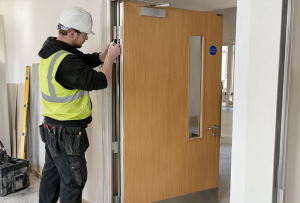
To remain compliant for insurance purposes, a fire door must be a complete fire door set. An insurer won’t just look at the wood; they look at the components:
- Intumescent Seals: These expand when heated to seal the gap between the door and the frame. If they are painted over or missing, the door is non-compliant.
- Self-Closing Devices: Every fire door must close reliably from any angle. A door that is wedged open is a total failure of the fire strategy.
- Gaps and Clearances: The gap between the door leaf and the frame should be between 2mm and 4mm. A gap wider than a £1 coin (approx. 3mm) is often a sign of non-compliance.
- Certified Hardware: Hinges, locks, and handles must be fire-rated and carry the CE/UKCA mark.
4. The Importance of Professional Inspections
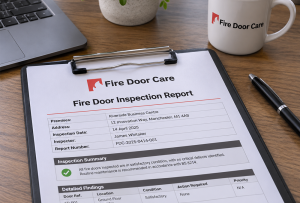
While in-house visual checks are great for day-to-day safety, insurance companies often require proof of professional inspections.
| Inspection Type | Frequency | Conducted By |
| Visual Check | Monthly | Internal Staff |
| Routine Inspection | Every 6 Months | Competent Person (e.g, FDIS certified) |
| High-Traffic Areas | Quarterly | Certified Professional |
You can learn more about inspecting a fire door in our blog post Fire Door Inspection Checklist: What You Need to Do Each Year.
Pro Tip: Always keep an Inspection Log. If you cannot produce a paper trail showing when a door was last checked and repaired, an insurer may treat the door as non-maintained.
5. Conclusion: Protecting Your Property and Your Policy
Fire doors are the silent guardians of your commercial property. By ensuring they meet the BS 476 or BS EN 1634 standards and maintaining a rigorous inspection schedule, you do more than stay legal. You ensure that your insurance policy remains a valid safety net rather than a useless piece of paper.
Don’t wait for an audit. The best time to check your fire doors was yesterday; the second best time is today.
Why Choose Fire Door Care?
Protect your property and ensure safety with our expert fire door services! We specialize in professional fire door installation, inspection, and repair ensuring full compliance with fire door regulations. Our certified team delivers high-quality solutions to enhance fire resistance, prevent smoke spread, and safeguard lives. Whether you need a new fire door, routine inspections, or urgent repairs, we provide reliable and cost-effective services tailored to your needs.
If you would like to find out more about our fire door services, or would like help, advice or a quote please feel free to call us on 0203 488 5923 or send us a message here.