Who is The Responsible Person in Fire Safety? In the world of fire safety, one role is paramount: the Responsible Person (RP). This isn’t just an informal title; it’s a legal designation with significant duties for ensuring the safety of a building’s occupants.
Understanding who the Responsible Person is, what their duties entail, and the serious implications of non-compliance is essential for anyone who owns, manages, or occupies non-domestic premises.
This guide breaks down the critical aspects of this crucial role, primarily under the UK’s Regulatory Reform (Fire Safety) Order 2005 (FSO), as amended by subsequent legislation like the Fire Safety Act 2021 and the Building Safety Act 2022.
Defining the Responsible Person in Fire Safety
The concept of the Responsible Person ensures there is always a clearly accountable individual or organisation for fire safety within a premises.
Who is the Responsible Person?
The Responsible Person is the individual or organisation that has control of the premises and is responsible for fire safety in a business or non-domestic building. This can be:
- An employer in a workplace.
- The owner of the building.
- The landlord or freeholder.
- An occupier or tenant.
- Facilities managers.
- Building managers.
- Managing agents.
Crucially, the Responsible Person is often a legal entity (like a limited company) rather than a living individual, although they must appoint competent staff to carry out the necessary duties.
What Premises Require a Responsible Person?
The FSO and related legislation cover nearly all non-domestic premises in England and Wales, including:
- Workplaces and commercial premises.
- Premises the public have access to (shops, theatres, etc.).
- The common parts of multi-occupied residential buildings (such as corridors, stairways, and plant rooms in blocks of flats).
For multi-occupied residential buildings, the Fire Safety Act 2021 clarified that the RP’s duties extend to the external walls (including cladding and balconies) and all doors between domestic premises and the common parts.
Multiple Responsible Persons
It’s common for a premises to have more than one Responsible Person. For example, a landlord may be the RP for the common parts of an office building, while the tenant is the RP for their specific floor or unit (the workplace).
Where there are multiple RPs, they must cooperate and coordinate their fire safety measures to ensure the safety of all people on the premises.
Core Duties of the Responsible Person
The duties of the Responsible Person are legally mandated and form the backbone of a robust fire safety management system.
1. Conduct and Review a Fire Risk Assessment (FRA)
This is the cornerstone of the RP’s duties. The RP must ensure a suitable and sufficient fire risk assessment is carried out by a competent person.
The FRA is a careful look at a premises and the activities carried out there to identify:
- Fire hazards (e.g. ignition sources, flammable materials).
- The people at risk and how they might be harmed.
- Measures that need to be taken to remove or reduce the risk of fire.
The FRA must be regularly reviewed and updated, especially if there are significant changes to the building’s structure, use, or occupancy.
Following the Building Safety Act 2022 amendments, all RPs must now record the FRA in full, regardless of the size of the business or number of employees.
2. Implement and Maintain Fire Safety Measures
The RP must act on the findings of the FRA, implementing appropriate preventive and protective measures. This includes:
- Providing and maintaining adequate fire detection and warning systems (fire alarms).
- Ensuring routes to emergency exits are kept clear at all times and that emergency lighting is functional.
- Providing and maintaining necessary firefighting equipment (extinguishers).
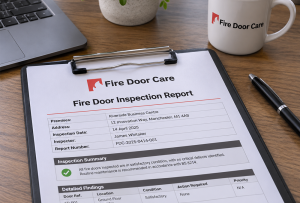
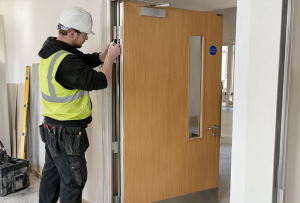
- Ensuring the fire doors are correctly fitted and maintained.
3. Create and Communicate an Emergency Plan
A clear and effective emergency plan is vital. The RP must develop, implement, and communicate a plan that details:
- Evacuation procedures for all occupants.
- The location of assembly points.
- The role of Fire Wardens/Marshals.
This plan should be tested with regular fire drills to ensure all occupants know what to do in the event of a fire.
4. Provide Information, Instruction, and Training
The RP must ensure that staff and other relevant persons are provided with adequate fire safety information and training. This includes:
- Informing staff about the risks identified in the FRA.
- Providing instruction on the correct use of fire safety equipment.
- Ensuring all employees receive fire awareness training upon induction and refreshers as necessary.
5. Ensure Competency
The RP must only appoint a person to assist them in their fire safety duties, such as conducting the FRA, if that person is competent. This means they must have the necessary skills, knowledge, and experience.
In fire safety, the distinction between a Responsible Person and an Accountable Person centres on their legal duties and scope of responsibility, particularly in multi-occupied residential buildings in England under new legislation.
Responsible Person vs Accountable Person in Fire Safety
Responsible Person
The Responsible Person (RP) is a well-established concept from the Regulatory Reform (Fire Safety) Order 2005 (FSO).
- Role Focus: They are responsible for ensuring the general fire safety of non-domestic premises (including common parts of multi-occupied residential buildings) and ensuring a suitable and sufficient fire risk assessment is carried out.
- Legal Duty: Their duties are primarily operational and relate to the management of general fire precautions.
Accountable Person
The Accountable Person (AP) is a role introduced by the Building Safety Act 2022 and applies specifically to higher-risk residential buildings (HRRBs).
- Role Focus: They have a broad responsibility for managing building safety risks in the occupied parts of the building, focusing on structural safety and fire spread.
- Legal Duty: Their duties are strategic and legal, including providing a safety case report and ensuring the residential parts of the building comply with the “building safety case regime.”
The Consequences of Non-Compliance
Being the Responsible Person carries a heavy weight of legal liability. Fire safety is a matter of life and death, and the law treats non-compliance severely.
Enforcement and Penalties
Local Fire and Rescue Authorities (FRAs) are the main enforcing body. If an FRA finds a breach of the fire safety regulations, they can issue notices:
- Alterations Notice: Issued if the FRA believes any change in the premises will constitute a serious risk.
- Enforcement Notice: Specifies the contraventions and the remedial actions that must be taken, along with a compliance deadline.
- Prohibition Notice: Issued if the risk is so serious that the use of the premises (or part of it) must be prohibited or restricted immediately.
Recent Legislative Changes
Recent legislative changes have only strengthened the RP’s obligations and accountability:
- Building Safety Act 2022 (Section 156): Strengthens fire safety requirements by requiring all RPs to record their FRA in full and formalises the requirement for RPs to cooperate and share information with other RPs and residents.
- Fire Safety (England) Regulations 2022: Introduces new duties for RPs in high-rise residential buildings (over 18 metres or seven storeys), including requirements for monthly checks of lifts and providing design information to the Fire and Rescue Service.
The intent of these laws is to create a clearer, more accountable regime, making it easier for enforcing authorities to identify the Responsible Person and prosecute those who fail to comply.
Conclusion
The Responsible Person is more than just a job title; it is a legal duty to safeguard life. While the responsibilities are extensive, adhering to them is non-negotiable. Fire safety is an ongoing process of assessment, action, and review, not a one-off task.
By understanding and fulfilling the core duties, especially the crucial Fire Risk Assessment, the Responsible Person provides the essential leadership needed to keep people safe from the devastating impact of fire.
Why Choose Fire Door Care?
Protect your property and ensure safety with our expert fire door services! We specialize in professional fire door installation, inspection, and repair, ensuring full compliance with fire door regulations. Our certified team delivers high-quality solutions to enhance fire resistance, prevent smoke spread, and safeguard lives. Whether you need a new fire door, routine inspections, or urgent repairs, we provide reliable and cost-effective services tailored to your needs.
- Safety First: We prioritise protecting lives and properties by ensuring every fire door meets the highest safety standards.
- Uncompromising Quality: Our expert team delivers precision craftsmanship and reliable solutions for long-lasting fire protection.
- Integrity You Can Trust: We are committed to honest, transparent, and dependable service at every step of the process.
- Customer Focused: Your safety is our mission. We tailor every inspection, repair, and installation to your unique needs.
If you would like to find out more about our fire door services, or would like help, advice or a quote please feel free to call us on 0203 488 5923 or send us a message here.