Fire safety is paramount in any commercial setting, but perhaps nowhere more so than in manufacturing facilities. These environments often house a complex interplay of machinery, raw materials, finished products, and a significant workforce, all of which contribute to unique fire risks.
In the UK, robust regulations govern fire safety, and a critical component of this framework is the fire door.
This in-depth blog post will break down the UK regulations surrounding fire doors in manufacturing facilities and highlight the specific fire safety challenges inherent in such settings.
The Regulatory Reform (Fire Safety) Order 2005 (FSO)
The primary piece of legislation governing fire safety in non-domestic premises such as manufacturing premises in England and Wales is the Regulatory Reform (Fire Safety) Order 2005 (FSO). This Order places a legal duty on the Responsible Person (typically the employer, owner, or occupier) to take reasonable steps to reduce the risk from fire and ensure people can safely escape if a fire does occur.
Under the FSO, a key requirement is to conduct a suitable and sufficient fire risk assessment. This assessment will identify potential fire hazards, the people at risk, and the measures needed to eliminate or reduce that risk. Fire doors are almost always a crucial part of these measures.
The Role of Fire Doors in Manufacturing Facilities
Fire doors are not just ordinary doors; they are engineered safety devices designed to perform two vital functions in the event of a fire:
- Compartmentation: They are a critical element of a building’s compartmentation strategy. They help to contain a fire within a specific area for a defined period, preventing its spread to other parts of the building. This containment is essential for protecting escape routes and other valuable areas.
- Safe Evacuation: By holding back fire and smoke, fire doors allow occupants valuable time to evacuate the building safely. They protect escape routes, stairwells, and corridors, ensuring they remain clear of smoke and flames.
In a manufacturing facility, where fire can spread rapidly due to materials and processes, the integrity of fire doors can be the difference between a minor incident and a catastrophic event.
UK Regulations and Standards for Fire Doors
For fire doors to effectively perform their function, they must meet specific standards and be properly installed and maintained.
1. Certification and Fire Rating
All fire doors must be certified to a British Standard or European equivalent. The most common ratings you’ll encounter are:
- FD30: Provides 30 minutes of fire resistance.
- FD60: Provides 60 minutes of fire resistance.
- FD90/FD120: Provide 90 or 120 minutes of fire resistance, typically used in higher-risk areas or critical escape routes.
The required rating for a fire door in a manufacturing facility will be determined by the fire risk assessment, considering factors such as the building’s size, layout, fire load, and escape routes.
You can learn more about fire door ratings here.
2. Components of a Fire Door Assembly
It’s crucial to understand that a fire door is not just the door leaf itself but an entire assembly, including:
- Door Leaf: The actual door, constructed with fire-resistant materials.
- Frame: The frame must also be fire-rated and properly installed to prevent fire bypassing it.
- Ironmongery: Hinges, locks, latches, and closers must be fire-rated and robust enough to withstand high temperatures.
- Intumescent Strips: These strips are fitted into the frame or door edge and expand when exposed to heat, sealing the gap between the door and the frame to prevent the passage of smoke and hot gases.
- Smoke Seals: Often combined with intumescent strips, these prevent the passage of cold smoke, which can be just as dangerous as fire.
- Self-Closing Devices: Crucially, fire doors must automatically close. This is typically achieved with an overhead door closer or concealed closers. Fire doors must never be propped open, as this completely negates their purpose.
3. Installation and Maintenance
The effectiveness of a fire door hinges on its correct installation and ongoing maintenance and repairs.
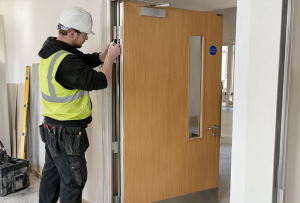
- Installation: Fire doors must be installed by competent individuals, ideally certified under a third-party accreditation scheme. Incorrect installation can compromise the fire resistance, even if the door itself is certified.
- Maintenance: The Responsible Person has a legal duty to ensure fire doors are regularly inspected and maintained. This includes checking the integrity of the door leaf and frame, the functionality of closers, and the condition of intumescent strips and smoke seals. Any defects must be rectified promptly.
Fire Safety Challenges in Manufacturing Facilities
Manufacturing facilities present a unique set of fire safety challenges that demand careful consideration in the fire risk assessment and the specification of fire doors.
High Fire Load
Many manufacturing processes involve the storage and use of significant quantities of combustible materials – raw materials, packaging, chemicals, oils, and finished goods. This high fire load means that if a fire starts, it can escalate rapidly and intensely, requiring robust compartmentation.
Flammable Materials and Processes
- Chemicals: Storage and use of flammable liquids, gases, and reactive chemicals.
- Dusts: Processes generating combustible dusts (e.g. wood dust, metal dusts, flour) which can lead to dust explosions.
- Welding/Cutting: Hot work activities introducing ignition sources.
- Machinery: Overheating machinery, electrical faults, and friction can all be ignition sources.
Complex Layouts and Large Areas
Manufacturing plants often feature large open areas, interconnected workshops, and mezzanine levels. This can make compartmentation more challenging and dictate the need for strategic placement and higher fire ratings for doors in certain areas.
Obstructions and Access
Production lines, stored materials, and machinery can obstruct escape routes and prevent fire doors from operating effectively. Clear access to and around fire doors is paramount.
Noise and Communication
High noise levels from machinery can impair audible fire alarms and make communication during an evacuation difficult. This underscores the need for clear signage and well-practiced evacuation procedures.
Staff Training and Discipline
A diverse workforce, potentially including temporary staff or contractors, requires rigorous and ongoing fire safety training. Ensuring that fire doors are never propped open and that staff understand their critical role is vital.
Ventilation Systems
Industrial ventilation and extraction systems, while essential for air quality and process control, can also inadvertently spread fire and smoke if not designed and maintained with fire safety in mind. Fire dampers in ducts that pass through fire-rated walls are crucial.
Automated Systems
While offering efficiency, automated systems and robotics can also present challenges regarding emergency shutdown procedures and ensuring they do not impede evacuation or fire suppression efforts.
Considerations for Fire Doors in Manufacturing Facilities
Given these challenges, here are some practical considerations for fire doors:
- Location: Fire doors should be strategically placed to protect escape routes, separate high-risk processes from lower-risk areas, and contain potential fires.
- Size and Operation: Large openings for machinery or vehicles may require specialist fire-rated roller shutters or sliding fire doors, which must still comply with relevant standards and self-closing mechanisms.
- Signage: All fire doors must be clearly marked with “Fire Door Keep Shut” or “Fire Door Keep Locked” (depending on the specific door) signage.
- Regular Inspections: Beyond formal maintenance, staff should be encouraged to report any damage or issues with fire doors immediately.
- Emergency Lighting: Escape routes, including those protected by fire doors, must have adequate emergency lighting.
- Access Control Integration: If fire doors are part of an access control system, it’s vital that they automatically unlock or fail-safe in the event of a fire alarm to allow for unimpeded escape.
Conclusion
Fire doors are an indispensable element of fire safety in UK manufacturing facilities. They are not merely an afterthought but a critical component of a comprehensive fire safety strategy mandated by the Regulatory Reform (Fire Safety) Order 2005.
The unique challenges of manufacturing environments; high fire loads, flammable processes, and complex layouts, amplify the importance of correctly specified, installed, and meticulously maintained fire doors.
Why Choose Fire Door Care?
Protect your property and ensure safety with our expert fire door services! We specialize in professional fire door installation, inspection, and repair, ensuring full compliance with fire door regulations. Our certified team delivers high-quality solutions to enhance fire resistance, prevent smoke spread, and safeguard lives. Whether you need a new fire door, routine inspections, or urgent repairs, we provide reliable and cost-effective services tailored to your needs.
- Safety First: We prioritise protecting lives and properties by ensuring every fire door meets the highest safety standards.
- Uncompromising Quality: Our expert team delivers precision craftsmanship and reliable solutions for long-lasting fire protection.
- Integrity You Can Trust: We are committed to honest, transparent, and dependable service at every step of the process.
- Customer Focused: Your safety is our mission. We tailor every inspection, repair, and installation to your unique needs.
If you would like to find out more about our fire door services, or would like help, advice or a quote please feel free to call us on 0203 488 5923 or send us a message here.