In the UK, fire safety is non-negotiable for all commercial premises, and gyms are certainly no exception. As busy, often high-energy environments with a large volume of people, a unique set of challenges accompanies ensuring a safe and effective evacuation route. A critical component of your fire safety strategy is the proper use, maintenance, and compliance of your fire doors.
This in-depth guide is tailored for gym owners, managers, and the designated ‘Responsible Person’ in the UK, explaining the regulations and the specific challenges your premises face.
Unique Fire Safety Challenges in a Gym
Gyms present several distinct factors that make fire door compliance and overall fire safety more challenging than in a standard office environment:
High Occupancy
A higher number of people, often unfamiliar with the building layout, requires faster and clearer evacuation routes, putting immense pressure on fire doors to perform correctly.
Obstruction Risk
Gyms are filled with equipment: free weights, yoga mats, medicine balls, and members’ bags. Any of these can be accidentally or carelessly placed, blocking or wedging a fire door open.
Changing Rooms/Showers
These areas often have high humidity, which can cause wooden fire doors to swell or warp, potentially compromising the crucial gap sizes around the frame and leading to failure.
High Wear and Tear
Doors in busy public areas like gyms are subject to constant, heavy use. This increases the risk of damage to the door leaf, frame, hinges, and seals, all of which compromise the door’s fire rating
Electrical Equipment
Cardio machines and sound systems are numerous, increasing the potential for an electrical fire, requiring a robust compartmentation strategy.
The Role of The ‘Responsible Person’
The core legislation is the Regulatory Reform (Fire Safety) Order 2005 (RRFSO). This law applies to virtually all non-domestic premises, including gyms and leisure centres.
The RRFSO places the legal duty for fire safety on the ‘Responsible Person‘. This could be the employer, owner, or any person who has control of the premises. The Responsible Person’s key duties include:
- Carrying out a Fire Risk Assessment (FRA): This must be thorough, up-to-date, and specifically consider the risks in a gym environment.
- Implementing Appropriate Measures: This includes providing adequate means of escape, fire detection, and, crucially, maintaining fire doors.
- Maintenance: Article 17 of the RRFSO requires that fire doors are “subject to a suitable system of maintenance and are maintained in an efficient state, in efficient working order and in good repair.”
The Critical Role of Fire Doors
Fire doors are not just any old door; they are a vital part of your building’s passive fire protection system. They serve two primary functions:
- Compartmentation: They are designed to contain fire and smoke within a specific area for a set period (FD30 for 30 minutes, FD60 for 60 minutes, etc.), preventing its spread throughout the building.
- Protection of Escape Routes: By compartmentalising the fire, they keep stairwells, corridors, and other designated escape routes clear for staff and members to evacuate safely.
Your Fire Risk Assessment will determine where fire doors are required and what fire-resistance rating they must have. They are typically required in:
- Doorways leading to escape routes.
- Doors to high-risk areas like boiler rooms, server rooms, or large storage areas.
Fire Door Compliance: What to Check Regularly
Due to the high-traffic nature of a gym, regular, systematic checks are essential. The law requires ongoing maintenance. Here are the key components you, as the Responsible Person, must monitor:
1. The 5-Point Check
- Certification: Check for the certification label/plug on the top edge of the door (often on the hinge side) to confirm it is a genuine fire door (e.g. FD30, FD60).
- Gaps: The gap between the door and the frame should be consistent and generally no more than 3mm. A larger gap allows smoke and fire to pass through.
- Seals (Intumescent & Smoke): Check that the intumescent strips (which expand with heat) and smoke seals (brushes or blades) are present and undamaged. They are vital for preventing the spread of deadly smoke.
- Hinges: Ensure all three or more hinges are firmly fixed with no missing screws. They must be fire-rated and undamaged.
- Closer: The self-closing device is arguably the most critical component in a gym. It must close the door fully and securely into the frame from any open position.
2. Preventing Wedging – A Gym-Specific Challenge
You must have strict policies to ensure fire doors are never wedged open. This is a common practice in gyms to increase air circulation or ease access but is illegal and dangerous.
The only legal exception is the use of an approved, acoustically activated “hold-open device” that is linked to the fire alarm system and automatically releases, allowing the door to close upon hearing the alarm.
3. Clear Signage
All fire doors that must be kept shut (i.e. those not fitted with approved hold-open devices) must display the sign: FIRE DOOR KEEP SHUT.
Any door on an escape route should also be clearly marked with the appropriate Fire Exit signage.
Maintenance and Inspection Frequency
While the RRFSO doesn’t set a hard and fast rule on fire door inspection frequency for all premises, best practice and industry guidance suggest:
- Daily Visual Checks: Staff should be trained to perform simple visual checks (the 5-point check) at the start or end of a shift to spot immediate issues like wedging or damage.
- 6-Monthly Inspections: For busy commercial premises like gyms, a formal, documented inspection of all fire doors by the Responsible Person or a competent person should be carried out at least every six months.
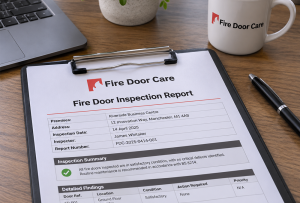
- Annual Professional Inspection: It is highly recommended to have a full, in-depth inspection conducted by a third-party accredited fire door inspector at least annually.
You can learn more about fire doors inspections in our blog post Fire Door Inspection Checklist: What You Need to Do Each Year.
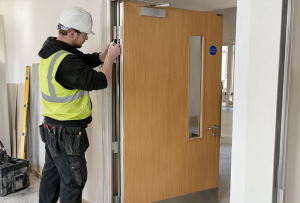
Remember, the installation and any remedial work must always be carried out by a competent and certified person to ensure the door retains its fire-resistant integrity.
Compliance with fire door regulations is not just a legal requirement; it is a moral obligation to every person who walks through your gym’s doors.
Conclusion
In the high-energy, high-traffic environment of a modern gym, fire door compliance moves beyond a simple tick-box exercise; it is the most crucial component of your passive fire safety strategy.
The legal burden, set by the Regulatory Reform (Fire Safety) Order 2005, rests squarely on the shoulders of the Responsible Person to ensure all fire doors are correctly specified (e.g. FD30 or FD60), properly installed, and meticulously maintained.
The biggest challenge in a gym is preventing obstruction and wedging. Therefore, constant vigilance, rigorous staff training, and documented, regular inspections are non-negotiable.
By maintaining the integrity of every fire door, ensuring the seals, closers, and structure are sound, you guarantee the essential compartmentation needed to protect escape routes and safeguard the lives of everyone using your facility.
Don’t compromise on a safety feature that only gets one chance to work.
Why Choose Fire Door Care?
Protect your property and ensure safety with our expert fire door services! We specialize in professional fire door installation, inspection, and repair, ensuring full compliance with fire door regulations. Our certified team delivers high-quality solutions to enhance fire resistance, prevent smoke spread, and safeguard lives. Whether you need a new fire door, routine inspections, or urgent repairs, we provide reliable and cost-effective services tailored to your needs.
- Safety First: We prioritise protecting lives and properties by ensuring every fire door meets the highest safety standards.
- Uncompromising Quality: Our expert team delivers precision craftsmanship and reliable solutions for long-lasting fire protection.
- Integrity You Can Trust: We are committed to honest, transparent, and dependable service at every step of the process.
- Customer Focused: Your safety is our mission. We tailor every inspection, repair, and installation to your unique needs.
If you would like to find out more about our fire door services, or would like help, advice or a quote please feel free to call us on 0203 488 5923 or send us a message here.