Fire exit doors are critical components of any building’s passive fire protection strategy, providing an unimpeded route to safety during an emergency. Understanding their role, legal standards, and operational guidelines is essential for property managers, business owners, and landlords across the UK.
What Is a Fire Exit Door?
A fire exit door (often called a final exit door) is an external door designed to allow fast, unimpeded evacuation from a building into an ultimate place of safety outside.
Fire Exit Doors vs. Fire Doors
It is vital to distinguish between a fire exit door and an internal fire door:
- Fire Exit Doors: Located on external walls. Their primary function is rapid egress. They do not necessarily need to be fire-rated (unless specified in a fire risk assessment for external exposure), but they must open easily outward and never be locked from the inside while the building is occupied.
- Fire Doors: Located internally to divide a building into fire compartments. Rated for fire resistance (e.g., FD30 or FD60 for 30 or 60 minutes), their main purpose is to block the spread of smoke and flame to protect escape routes.
Key UK Legislation and Building Regulations Governing Fire Exits
Several pieces of statutory law and building guidance govern fire exit doors across England, Wales, Scotland, and Northern Ireland:
- Regulatory Reform (Fire Safety) Order (RRFSO): Places the legal responsibility on a designated Responsible Person (employer, building owner, or landlord) to carry out fire risk assessments and ensure emergency routes and exits remain clear, operable, and well-maintained.
- Fire Safety Act & Fire Safety (England) Regulations: Clarified responsibilities for multi-occupied residential buildings, introducing mandatory checks for communal and entrance doors.
- Building Regulations Approved Document B: Outlines the design standards, door widths, travel distances, and opening mechanisms required for new builds and major refurbishments in England and Wales.
- Code of Practice for Fire-Resisting and Smoke Control Doors: Benchmark covering timber, composite, and metal doorsets, installation tolerances, and maintenance.
Operational Standards and Hardware Requirements
Under fire safety regulations, emergency exit routes and doors must allow immediate escape without the use of a key.
Hardware Types
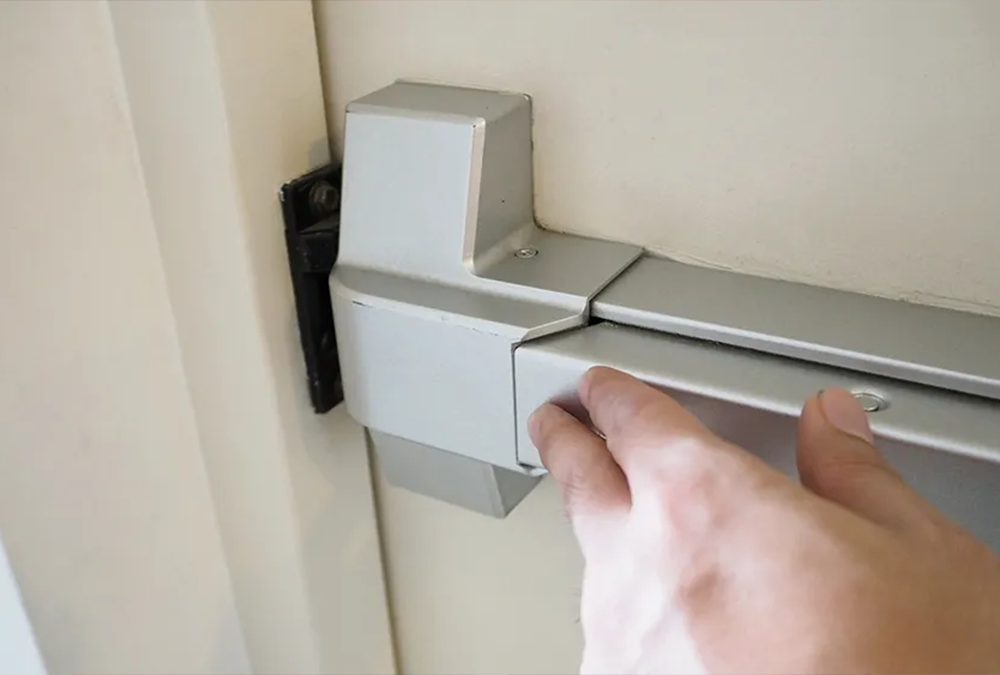
- Panic Bars: Required in public buildings (venues, retail, assembly halls) where occupants are unfamiliar with the layout. Designed to operate under light pressure even if crowds are pressing against the door in a panic.
- Push Pads and Lever Handles: Permitted in non-public workplaces (offices, private workshops) where all occupants are trained employees familiar with the escape routes.
Door Direction and Width
- Outward Opening: Fire exit doors must open in the direction of escape (outwards) whenever practicable, and mandatory if the space serves more than 60 people.
- Clear Widths: General minimum width starts at 750 mm for lower occupancy, scaling up depending on the total calculated occupant load for the zone. Corridors leading to final exits must maintain unobstructed clearance.
Signage and Emergency Lighting Standards
All fire exit routes and doors must be identifiable, even during a total power failure.
| Feature | Standard Requirement | Purpose |
| Photoluminescent Signs | Compliant “Running Man” pictograms | Ensures directional guidance in dark or smoke-filled environments. |
| Door Hardware Marking | “Push Bar to Open” or “Fire Exit Keep Clear” | Clear instruction at the point of egress. |
| Emergency Lighting | Fitted near exits and changes of direction | Illuminates the exit door threshold during main power failures. |
Maintenance, Inspection, and Penalties for Non-Compliance
Fire exit doors require ongoing functional checks to ensure they do not become stuck, blocked, or damaged.
- Regular Inspection Routine: Perform weekly visual checks to confirm doors open smoothly without binding, latching hardware functions, and routes outside are completely clear of rubbish, vehicles, or storage.
- Third-Party Certification: Ensure repairs or replacements use certified installers and components that preserve the door system’s integrity.
- Consequences of Breaches: Failure to maintain clear fire exits can result in penalties like enforcement or prohibition notices from local Fire and Rescue Services, unlimited financial fines, and prison sentences for serious negligence.
Conclusion
Maintaining compliant fire exit doors is not just about fulfilling a legal mandate under UK safety law – it is a foundational responsibility for protecting lives. By choosing the right hardware, maintaining clear routes, and conducting regular inspections, building owners and managers can ensure their premises remain safe, accessible, and fully prepared for any emergency.
Why Choose Fire Door Care?
Fire Door Care are LPCB certified meaning your can have total confidence in our work and your compliance. We specialize in the full lifecycle of fire door safety. From initial inspections and identifying hardware failures to the precision installation of fire-rated components, we ensure your property meets all current safety standards.
Our certified team delivers high-quality solutions to enhance fire resistance, prevent smoke spread, and safeguard lives. Whether you need a new fire door, routine inspections, or urgent repairs, we provide reliable and cost-effective services tailored to your needs.
- Safety First: We prioritise protecting lives and properties by ensuring every fire door meets the highest safety standards.
- Uncompromising Quality: Our expert team delivers precision craftsmanship and reliable solutions for long-lasting fire protection.
- Integrity You Can Trust: We are committed to honest, transparent, and dependable service at every step of the process.
- Customer Focused: Your safety is our mission. We tailor every inspection, repair, and installation to your unique needs.
If you would like to find out more about our fire door services, or would like help, advice or a quote please feel free to call us on 0203 488 5923 or send us a message here.