The landscape of passive fire protection has fundamentally transformed, placing a rigorous focus on building safety and clear information management.
At the center of this transformation sits BS 8214:2026 (Fire-resisting and smoke control doors – Practical considerations concerning specification, design and performance in use – Code of practice). Replacing the decade-old 2016 edition, this updated code of practice represents a monumental shift for building managers, landlords, inspectors, and safety professionals.
What is the Scope of BS 8214:2026? Material Types Covered
Historically, BS 8214 was heavily associated with timber-based fire door assemblies. The 2026 revision changes this completely by establishing a unified material approach. It now covers pedestrian fire-resisting and smoke control doors across all primary construction materials:
- Timber (traditional laminated, particleboard, or solid timber cores).
- Steel (frequently used in commercial, high-traffic, and external applications).
- Aluminium (common in modern glazed systems and commercial entrance doors).
- Composite Systems (increasingly utilized in social housing and multi-occupancy front entrance doors).
This means that no matter what material a door is manufactured from, it must be designed, installed, inspected, and maintained under the same rigorous, system-level framework.
Why Fire Doors Must Be Managed as a Complete System
One of the costliest errors in fire safety management has been treating a fire door as a simple product, purchasing a fire-rated door leaf and pairing it with generic, uncertified hardware, frames, or seals.
BS 8214:2026 firmly outlaws this approach, introducing a strict complete system concept. A fire door is legally and technically defined as a coordinated, tested assembly comprising:
- The Leaf & Frame: Coordinated to ensure structural stability under thermal stress.
- Hardware and Ironmongery: Closers, hinges, locks, latches, and panic hardware must match the certified configuration.
- Seals & Glazing: Intumescent strips, cold smoke seals, and fire-resistant glass units.
- Structural Interfaces: The critical perimeter sealing between the outer frame and the surrounding wall structure.
If you replace a broken closer, swap out a hinge, or alter a seal, you are making a design decision. Under BS 8214:2026, any such change must be justified by robust, test-backed supporting evidence (such as Field of Application reports or direct test data). Without evidence, the door is non-compliant.
Key Technical Specifications for Fire Door Gaps and Smoke Seals
The revised standard introduces precise recommendations to eliminate site-level guesswork and improve real-world performance.
Structural Frame Interfaces
BS 8214:2026 tightens the rules on sealing the gap between the door frame and the wall structure. Historically, installers frequently filled these gaps with generic expanding foams. The 2026 standard clarifies acceptable evidence for backing materials such as stone wool, specific intumescent mastics, and tested, fire-rated foam sealants. Installers must use products explicitly tested for that specific wall-and-frame construction type.
Smoke Sealing and Under-Door Gaps
Smoke control requirements have been updated to ensure maximum containment:
- Fire-only Performance: The threshold gap can be anything workable up to the maximum permitted in the manufacturer’s test evidence.
- Fire & Smoke Performance: To ensure smoke containment (crucial for protecting escape corridors), threshold gaps should be kept between 5mm and the maximum permitted by the design, allowing drop seals to deploy and compress effectively.
Common Maintenance Issues for Timber, Steel, and Composite Fire Doors
Because BS 8214:2026 covers multiple materials, maintenance teams must be trained on the distinct ways these materials behave under stress:
Timber Doors
- Moisture Sensitivity: Bowing, twisting, or cupping due to humidity changes can prevent the door leaf from seating flat against the stops, compromising the cold smoke seal.
- Rebate Damage: Splits or gouges in the timber rebates directly interfere with the expansion of the intumescent strips during a fire.
Steel & Aluminium Doors
- Mechanical Wear: Look for sheet separation, loose internal reinforcing plates, or failing weld joints.
- Thermal Bridging: Metal conducts heat rapidly. Maintenance must ensure that internal insulating cores (such as mineral board) are intact and have not settled or degraded.
- Hardware Fastenings: Screws can strip out of thin metal skins if high-traffic door closers are poorly secured. Ensure heavy-duty blind rivets or backplates are intact.
Composite Doors
- Skin Integrity: Deep scratches or cracks in the outer Glass Reinforced Plastic (GRP) or thermoplastic skins can expose the inner insulating core (frequently foam or timber composite) to moisture ingress or physical damage.
- Core Compatibility: Fixings for hinges and locks must be explicitly compatible with the composite’s inner core density to prevent stripping under load.
Step-by-Step Fire Door Compliance Workflow Under BS 8214:2026
Under BS 8214:2026, the concept of “doing what has always worked” is entirely obsolete. The standard demands a full lifecycle approach to traceability.
1.Establish the Evidence Base
Prerequisite for any maintenance work. Before carrying out repairs, locate and digitize the original Field of Application (FoA) reports, fire test data, and manufacturer instructions for every door type in your facility. This is your baseline.
2.Conduct Inspections by a Competent Person
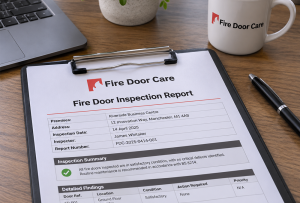
Competency is a regulatory mandate. Ensure inspectors possess demonstrable skills, knowledge, and experience specific to the materials they are inspecting (e.g., steel vs. timber). Record physical gaps, hardware operation, and seal integrity.
3.Verify Component Compatibility
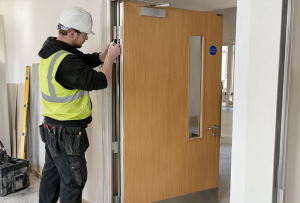
Never substitute in isolation. If hardware or seals require replacement, match them exactly to the tested configurations in the FoA report. Do not substitute different brands or specs unless supported by a written technical assessment from a competent body.
4.Update the Digital Log
Completing the compliance loop. Log the inspection date, specific defect terminology, actions taken, and the test data justifying the compatibility of the parts used. This creates a continuous, auditable record.
Conclusion: Mastering Your Next Safety Audit
Implementing BS 8214:2026 is ultimately about moving from assumption to evidence. By treating fire doors as unified systems, training staff on material-specific behaviors, and requiring solid test documentation for every minor repair, building managers can confidently prove their compliance under the modern regulatory regime.
Why Choose Fire Door Care?
Fire Door Care are LPCB certified meaning your can have total confidence in our work and your compliance. We specialize in the full lifecycle of fire door safety. From initial inspections and identifying hardware failures to the precision installation of fire-rated components, we ensure your property meets all current safety standards.
Our certified team delivers high-quality solutions to enhance fire resistance, prevent smoke spread, and safeguard lives. Whether you need a new fire door, routine inspections, or urgent repairs, we provide reliable and cost-effective services tailored to your needs.
- Safety First: We prioritise protecting lives and properties by ensuring every fire door meets the highest safety standards.
- Uncompromising Quality: Our expert team delivers precision craftsmanship and reliable solutions for long-lasting fire protection.
- Integrity You Can Trust: We are committed to honest, transparent, and dependable service at every step of the process.
- Customer Focused: Your safety is our mission. We tailor every inspection, repair, and installation to your unique needs.
If you would like to find out more about our fire door services, or would like help, advice or a quote please feel free to call us on 0203 488 5923 or send us a message here.