Fire safety in commercial buildings is not just a matter of best practice; it’s a legal requirement. Central to any building’s fire protection strategy are fire doors. These are critical components designed to contain the spread of fire and smoke, providing occupants with a safe route to exit and allowing emergency services to access the building.
This comprehensive guide explores every aspect of commercial fire doors, including their regulations, compliance, inspections, installation, repairs, and unique considerations across different types of commercial properties.
Table of Contents
- What Are Commercial Fire Doors?
- Types of Commercial Buildings
- Why Fire Doors Are Essential
- Fire Door Classifications & Ratings
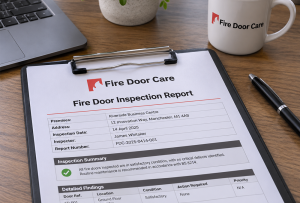
- Fire Door Regulations and Legal Compliance
- Fire Door Installation Standards
- Routine Inspections & Maintenance Requirements
- Common Issues and Fire Door Repairs
- Fire Safety Challenges by Building Type
- Choosing the Right Fire Door Supplier & Installer
- Conclusion
1. What Are Commercial Fire Doors?
Fire doors are specially engineered doors built to resist the spread of fire and smoke for a specified period, typically 30, 60, 90, or 120 minutes. A commercial fire door is a fire door installed in a non-residential setting, such as offices, warehouses, or public buildings, and must meet stricter requirements due to higher occupancy, risk levels, and operational complexity.
These doors are typically constructed with fire-resistant materials like:
- Solid timber core.
- Steel or aluminium facings.
- Intumescent seals that expand in heat.
- Smoke seals for draft protection.
2. Types of Commercial Buildings
Commercial buildings vary widely, and fire door requirements differ accordingly. Common categories include:
Office Buildings
Often multi-storey with shared occupancy. They have a high volume of people during working hours.
Retail Spaces
Shops, supermarkets, and shopping malls. Retail spaces require accessible fire exits and regular customer flow considerations
Industrial Facilities
Factories, workshops and warehouses, often containing flammable materials or heavy machinery.
Hospitality & Leisure
Hotels, restaurants, bars, cinemas and gyms. Hospitality and leisure venues have unique fire challenges due to overnight occupancy and public use.
Healthcare Buildings
Hospitals, clinics, and care homes. Here fire doors must accommodate mobility-impaired individuals.
Educational Institutions
Schools, colleges, and universities. Here there is an emphasis on controlled access and child safety.
Each building class has specific codes and risk factors that influence the type, placement, and number of fire doors required.
3. Why Fire Doors Are Essential
Fire doors perform the following vital roles:
- Contain Fire and Smoke: Prevent fire from spreading to escape routes and other compartments.
- Protect Escape Routes: Ensure corridors, staircases, and exits remain passable.
- Save Lives: Provide critical evacuation time.
- Minimize Property Damage: Isolate fire to specific compartments.
- Enable Firefighting Access: Allow safe entry for emergency services.
4. Fire Door Classifications & Ratings
Fire doors are rated by how long they can resist fire:
| Rating | Resistance Time | Typical Usage |
| FD30 | 30 Minutes | Offices, schools, light retail |
| FD60 | 60 Minutes | Hospitals, hotels, stairwells |
| FD90 | 90 Minutes | High-risk industrial areas |
| FD120 | 120 Minutes | Critical infrastructure, large facilities |
Key fire door components include:
- Door leaf.
- Frame and casing.
- Intumescent and smoke seals.
- Hinges (usually 3 minimum).
- Closers and latches.
- Vision panels (with fire-resistant glass).
You can learn more about fire door ratings in our blog post The Ultimate Guide to UK Fire Door Ratings.
5. Fire Door UK Regulations and Legal Compliance
- Regulatory Reform (Fire Safety) Order 2005 (RRO): Mandates that non-domestic premises have adequate fire precautions.
- Building Regulations Approved Document B: Covers fire safety in new and altered buildings.
- BS 476 & EN 1634 Standards: Set performance benchmarks for fire resistance.
Key responsibilities include:
- Fire risk assessments must be carried out regularly.
- Responsible persons (owners, landlords, facilities managers) must ensure fire doors meet legal standards.
- Doors must be third-party certified.
6. Fire Door Installation Standards
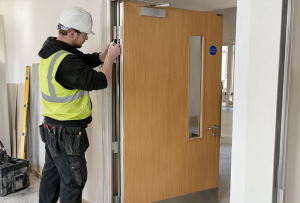
Proper fire door installation is as crucial as the door’s fire rating. Incorrect fitting can compromise the door’s integrity.
Best Practices:
- Use certified installers with experience in commercial fire doors.
- Ensure gaps around the door are within tolerances (usually 3-4mm).
- Ensure intumescent and smoke seals are correctly placed.
- Fire-rated hardware (hinges, closers, handles) must match the door’s rating.
- Avoid retrofitting non-approved components.
- Installation must follow BS 8214: Code of practice for fire door assemblies.
- Installation must follow the manufacturer’s installation guidelines.
7. Routine Inspections & Maintenance Requirements
Fire door inspections should be carried out at least every 6 months, or more frequently in high-traffic areas (e.g. every 3 months).
Inspection Checklist
- The door closes fully and latches correctly.
- Gaps between the door and frame are within acceptable range.
- No damage to seals, leaf, or glazing.
- Hinges and closers are in good condition.
- Certification labels are intact.
Repairs must be carried out immediately if issues are found. Maintenance records should be kept for compliance audits.
8. Common Issues and Fire Door Repairs
Fire doors are often damaged by everyday use. Common faults include:
- Broken or missing seals.
- Warped door leafs.
- Faulty closers or hinges.
- Inappropriate gaps.
- Unauthorized alterations (e.g. drilled holes for hardware).
Repairs should be done by certified technicians using approved materials. In some cases, doors must be replaced if integrity is compromised.
9. Fire Safety Challenges by Building Type
Each commercial property presents unique challenges:
Offices
- Shared tenancy complicates maintenance responsibilities.
- Higher risk of obstruction in corridors.
Retail
- Fire doors often wedged open for convenience which is illegal and dangerous.
- Stockroom doors need fire resistance and security integration.
Industrial
- Large spaces need compartmentation zones.
- High fire load from chemicals or flammables.
Hotels
- Bedroom fire doors must self-close silently.
- Staff training crucial for compliance.
You can learn more about fire doors in hotels in our blog post Fire Doors For Hotels – A Guide to UK Regulations and Compliance.
Schools
- Fire doors must balance safety with ease of use for children, often requiring hold-open devices linked to alarms.
- High traffic and potential for damage require more frequent inspections and robust construction.
You can learn more about fire doors in schools in the article UK Fire Door Regulations & Compliance – A Guide For Schools.
Healthcare
- Doors must be accessible to mobility-impaired individuals.
- Delayed closing or automatic hold-open systems are needed and must release on alarm.
You can learn more about fire doors in healthcare environments in the following two articles.
- Fire Doors for Hospitals and Healthcare Facilities: An In-Depth Guide
- Fire Door Regulations for Care Homes – An In-Depth Guide
10. Choosing the Right Fire Door Supplier & Installer
When selecting a fire door supplier or installer:
- Check for third-party certification.
- Request installation references from similar commercial settings.
- Ensure all components are certified and correctly matched.
- Choose suppliers that offer inspection, repair, and documentation support.
TOP TIP: Do not be tempted by budget options that may not meet legal or performance standards.
11. Conclusion
Commercial fire doors are more than just passive safety features—they are life-saving devices backed by rigorous standards and legal requirements. Proper selection, installation, and maintenance of fire doors can mean the difference between safe evacuation and tragedy.
All commercial building owners, managers, and tenants share responsibility for ensuring fire doors are fit for purpose. Regular inspections, awareness of fire door regulations, and working with qualified professionals form the backbone of a compliant and safe fire protection strategy.
Fire safety is not optional. It’s a legal and moral obligation.
Why Choose Fire Door Care?
Protect your property and ensure safety with our expert fire door services! We specialize in professional fire door installation, inspection, and repair, ensuring full compliance with fire safety regulations. Our certified team delivers high-quality solutions to enhance fire resistance, prevent smoke spread, and safeguard lives. Whether you need a new fire door, routine inspections, or urgent repairs, we provide reliable and cost-effective services tailored to your needs.
- Safety First: We prioritise protecting lives and properties by ensuring every fire door meets the highest safety standards.
- Uncompromising Quality: Our expert team delivers precision craftsmanship and reliable solutions for long-lasting fire protection.
- Integrity You Can Trust: We are committed to honest, transparent, and dependable service at every step of the process.
- Customer Focused: Your safety is our mission. We tailor every inspection, repair, and installation to your unique needs.
If you would like to find out more about our fire door services, or would like help, advice or a quote please feel free to call us on 0203 488 5923 or send us a message here.