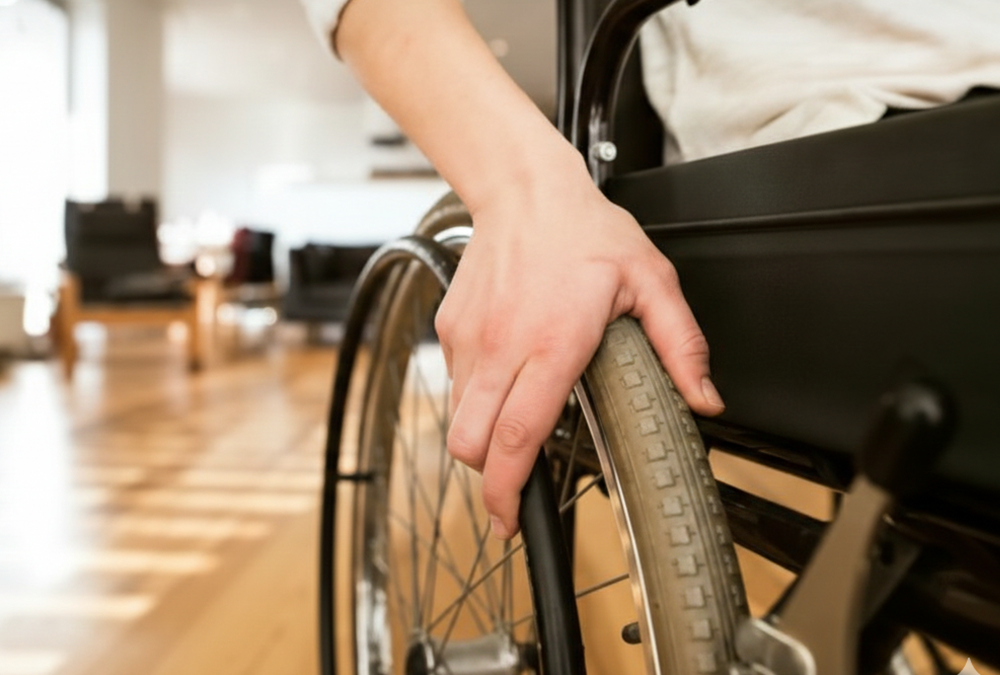
In the UK, fire doors are the front line of defense against the spread of smoke and flames. However, for a person with limited mobility or a visual impairment, a heavy, spring-loaded fire door can feel more like a barricade than a safety feature.
Striking the right balance isn’t just a matter of good design; it’s a legal requirement. Between the Equality Act 2010 and the Building Regulations, designers and building managers must ensure that fire safety never comes at the cost of inclusion.
What is an Accessible Fire Door?
At its simplest, an accessible fire door is a specialist life-safety device designed to perform two seemingly contradictory roles:
- Fire Protection: Like any standard fire door, it must act as a robust barrier against heat and smoke, typically rated for 30 or 60 minutes (FD30 or FD60).
- Ease of Access: It must be engineered so that individuals with limited physical strength, mobility issues, or sensory impairments can operate it without assistance.
Standard fire doors are often heavy and fitted with powerful self-closing devices to ensure they latch shut. However, for a person using a wheelchair or someone with limited upper-body strength, these doors can become impassable physical barriers. An accessible fire door solves this by using specific hardware and design standards to ensure the “opening force” required is kept to a minimum.
Legal Requirements: The Equality Act & Approved Document M
To stay compliant in the UK, you have to satisfy two different masters: fire safety (keeping the door closed) and accessibility (making the door easy to open).
- The Equality Act 2010: This is the overarching law. It mandates that service providers and employers make “reasonable adjustments” so that disabled people are not at a disadvantage.
- Approved Document M (ADM): This is the “how-to” guide for the Building Regulations regarding access. It sets the technical benchmarks for door widths, opening forces, and visibility.
- BS 8300-2:2018: This British Standard provides the code of practice for designing accessible and inclusive built environments, offering deeper detail than the Building Regulations.
Where Accessibility is Critical: Key Buildings and Scenarios
Accessibility isn’t just for specialist buildings; it is a fundamental requirement for any space used by the public or employees. Under Approved Document M, the following scenarios require specific attention to door accessibility:
- Healthcare Facilities: Hospitals and GP surgeries where patients may be using wheelchairs, crutches, or have reduced physical strength.
- Educational Settings: Schools and universities have to ensure that students with disabilities can move between classrooms independently.
- Public Service Buildings: Libraries, council offices, and museums that must provide “reasonable adjustments” for all citizens.
- Workplaces: Offices and factories where the Equality Act requires employers to ensure disabled staff are not disadvantaged.
- High-Density Residential: Common areas in blocks of flats, particularly sheltered housing or care homes, where elderly residents may struggle with heavy door closers.
Door Opening Force: Meeting the 30N and 22.5N Limits
One of the biggest hurdles in accessibility is the “opening force.” A fire door must have enough closing power to latch against air pressure and overcome the friction of intumescent seals, but it can’t be so heavy that a wheelchair user cannot push it open.
According to BS 8300 and Part M, the maximum allowable forces are:
- 30N (Newtons): To move the door from the closed position to an open angle of 30°.
- 22.5N (Newtons): To move the door from 30° to 60° of opening.
Top Tip: Many standard “overhead” door closers fail this test. If the force is too high, you may need to look at “Cam-Action” closers, which are engineered to be easier to open while still providing a firm closing force at the final stage.
Essential Hardware Solutions: Electromagnetic and Swing-Free Closers
How do you keep a door fire-safe without turning it into a physical barrier? Technology provides the answer. In high-traffic or sensitive areas, traditional mechanical closers are often replaced with:
- Electromagnetic Hold-Open Devices: These use an electric magnet to keep the door wide open during the day. If the fire alarm is triggered, the power cuts out, and the door closes automatically.
- Swing-Free Closers: These allow the door to behave like a standard bedroom door with no resistance. However, they are linked to the fire alarm and will forcefully shut the door if smoke is detected.
- Automatic Door Operators: These are fully motorized. They open the door at the push of a button or via a sensor, which is the gold standard for full accessibility in public entrances.
Visibility and Manoeuvring: Minimum Widths and Visual Contrast
Accessibility is about more than just the weight of the door; it’s about being able to see and navigate the space safely.
Clear Opening Widths
The “Effective Clear Width” (ECW) is the space available for a wheelchair to pass through when the door is open at 90°.
- Standard approach: Usually requires a minimum of 800mm.
- Narrow hallways/Angled approach: May require 825mm or 850mm to allow for the turning circle of a wheelchair.
Visual Contrast and Vision Panels
- LRV (Light Reflectance Value): Door handles and frames must contrast with the door leaf (a difference of at least 30 points on the LRV scale) to help visually impaired users.
- Vision Panels: To prevent collisions, vision panels must be placed so that a person in a seated position can see someone approaching from the other side. This typically covers a zone between 500mm and 1500mm from the floor.
You can learn more about glazing in fire doors in our blog post Can Fire Doors Contain Glazing? Everything You Need To Know.
Maintenance and Inspections: Ensuring Long-Term Compliance
A door that is accessible today might not be tomorrow. Under the Regulatory Reform (Fire Safety) Order 2005, building owners must maintain fire safety equipment. For accessibility, this means:
- Checking that hinges are lubricated (friction increases opening force).
- Ensuring intumescent seals haven’t expanded or become damaged, causing the door to stick.
- Testing that electromagnetic devices release immediately when the fire alarm sounds.
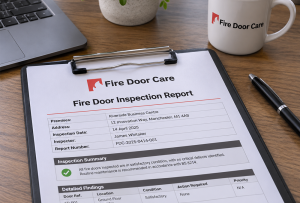
You can learn more about checking a fire door in our blog post Fire Door Inspection Checklist: What You Need to Do Each Year.
Conclusion: Safety and Inclusion Can Go Hand in Hand
Navigating the intersection of BS 8300 accessibility and Approved Document B fire safety is a delicate balancing act, but it is one that modern building design can no longer ignore. A fire door that is too heavy to open is a barrier to daily life, while a door that fails to close is a catastrophic safety risk.
By investing in the right hardware, such as electromagnetic hold-open devices or low-resistance cam-action closers, and maintaining strict adherence to opening force limits, you ensure your building is compliant, inclusive, and, above all, safe for every occupant. In the UK’s regulatory landscape, true safety is only achieved when protection is accessible to everyone.
Why Choose Fire Door Care?
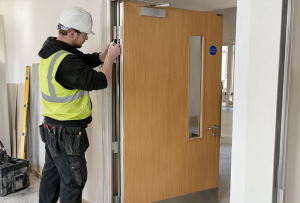
At Fire Door Care, we specialize in the full lifecycle of fire door safety. From initial inspections and identifying hardware failures to the precision installation of fire-rated components, we ensure your property meets all current safety standards.
Our certified team delivers high-quality solutions to enhance fire resistance, prevent smoke spread, and safeguard lives. Whether you need a new fire door, routine inspections, or urgent repairs, we provide reliable and cost-effective services tailored to your needs.
- Safety First: We prioritise protecting lives and properties by ensuring every fire door meets the highest safety standards.
- Uncompromising Quality: Our expert team delivers precision craftsmanship and reliable solutions for long-lasting fire protection.
- Integrity You Can Trust: We are committed to honest, transparent, and dependable service at every step of the process.
- Customer Focused: Your safety is our mission. We tailor every inspection, repair, and installation to your unique needs.
If you would like to find out more about our fire door services, or would like help, advice or a quote please feel free to call us on 0203 488 5923 or send us a message here.