For UK property developers, navigating the evolving landscape of fire safety is more critical than ever. With the regulatory environment shifting rapidly, driven by the Building Safety Act 2022, recent updates to the Fire Safety (England) Regulations, and the phased 2025/2026 amendments to Approved Document B, fire compliance is no longer a “check-the-box” exercise. It is a fundamental element of risk management, structural design, and legal liability.
One of the most frequent dilemmas developers face across residential and commercial portfolios is choosing between building from scratch (New Build) and transforming existing stock (Retrofitting).
While both routes must achieve the same ultimate goal; protecting human life and containing smoke and fire, the compliance journeys, structural hurdles, and cost frameworks for fire doors are radically different.
Fire Door Regulations UK: Comparing Compliance for New Builds vs. Retrofits
The very first distinction developers must understand is which piece of legislation dictates their project. Fire doors are not evaluated in a vacuum; they are judged by the context of the building work.
Approved Document B and the “Golden Thread” for New Build Developments
For new construction, Approved Document B (Fire Safety) dictates the minimum standards. The compliance pathway here is strict, highly documented, and leaves no room for improvisation.
- The BS EN 13501 Standard: As of recent updates, the UK has fully completed the transition away from old national fire test classifications (like BS 476). New builds must strictly standardise on European fire classifications (BS EN 13501) for material testing and fire resistance.
- The Golden Thread: Developers must maintain an unbroken digital record or “golden thread” of a door’s pedigree, from its manufacturing and third-party certification (e.g., BM TRADA Q-Mark or Certifire) to its precise installation logs.
- The Factory-Assembled Doorset: In a new build, you are rarely installing a separate door leaf into a site-built frame. Regulations heavily favor complete, factory-tested fire doorsets where the leaf, frame, ironmongery, and intumescent seals are certified together as a single engineered system.
Regulatory Reform (Fire Safety) Order: Compliance Guide for Retrofit Projects
When refurbishing, converting, or retrofitting an existing property, you are primarily governed by the Regulatory Reform (Fire Safety) Order 2005 alongside the updated Fire Safety Regulations.
- The Material Alteration Trigger: If your refurbishment involves a “material alteration” or change of use, any new door work must immediately step up to meet current Approved Document B standards.
- The Concept of Adequacy: Official updates clarify that for existing doors (such as flat entrance doors in multi-occupied buildings), developers and Responsible Persons do not always need to tear out older, functional “notional” fire doors to meet pristine new-build standards, provided they are regularly inspected, undamaged, self-closing, and deemed adequate by a professional Fire Risk Assessment (FRA).
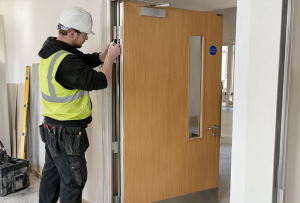
- The Challenge of Mismatched Parts: Retrofitting often involves replacing only a damaged leaf or upgrading an old frame with intumescent strips. This introduces a major risk: mixing components from different manufacturers can inadvertently void the door’s original fire rating.
Structural and Architectural Challenges: Fire Door Frame Fitting and Sizing Tolerances
The physical constraints of the building fabric dictate your fire door strategy.
Precision Engineering and Approved Layouts for New Build Projects
In a new build, the world is your architectural oyster. Openings are precision-engineered to perfectly match the dimensions of certified, pre-hung doorsets. Structural walls are built with the correct load-bearing capabilities and materials to hold fire-rated frames securely.
Furthermore, upcoming amendments to Approved Document B mandate stricter layout considerations, such as protected fire-resisting lobbies between flat entrance doors and common stairways. Incorporating these layouts is seamless when drawing them up on a computer-aided design (CAD) blueprint.
Adapting Fire Doors to Historic Substrates and Irregular Openings in Retrofits
Retrofitting fire doors into an older building, particularly installing fire doors in listed buildings or pre-1990s stock, presents a minefield of structural challenges:
- Irregular Structural Openings: Historic masonry or settled timber frames are rarely perfectly square or plumb. Fitting a rigid, certified fire doorset into an uneven opening requires specialist remedial carpentry to ensure compliance without compromising the surrounding wall’s fire integrity.
- Strict Gap Tolerances: To pass an inspection, a fire door must typically maintain a strict perimeter gap of 3mm to 4mm between the leaf and the frame. Achieving this in a warped, centuries-old corridor is an incredibly precise art.
- Asbestos and Substrate Unknowns: Drilling into existing walls to anchor new fire frames can disturb legacy hazardous materials, requiring costly abatement stops that can derail construction timelines.
Cost Analysis: New Build Doorsets vs. Retrofit Repairs
| Cost Factor | New Build Considerations | Retrofit Considerations |
| Procurement | Economical bulk-buying of standardized, factory-certified doorsets. | Higher unit costs for bespoke, made-to-measure doors or component upgrades. |
| Labour | Predictable, repeatable installation workflows integrated into the master build schedule. | High demand for highly skilled, accredited fire door joiners to handle bespoke adjustments. |
| Contingency | Minimal. Openings match specifications. | High. Hidden structural defects or failing frames often require unexpected remediation. |
While a new build demands a significant capital outlay upfront, its fire safety costs are highly predictable. Retrofitting, conversely, often looks cheaper on paper but can rapidly spiral due to unforeseen remedial variations required to pass final building control sign-off.
Legal Obligations: Routine Fire Door Inspection and Maintenance for Landlords
Whether a building is a shiny new landmark or a beautifully restored Victorian conversion, the legal obligation to maintain fire doors never ends.
Under current UK law, the Responsible Person (RP) must implement strict routine checks:
- Communal Areas: Fire doors in communal spaces must undergo visual checks every 3 months.
- Flat Entrances: In residential buildings over 11 metres in height, flat entrance doors must be checked at least every 12 months, verifying that self-closing devices work flawlessly and no unauthorized alterations (like uncertified letterboxes or retrofitted glazing) have been made.
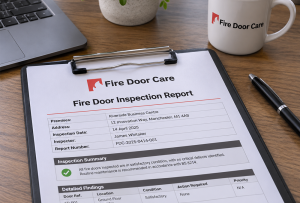
For new builds, these handovers are simplified by the clear digital footprint created during construction (meeting Regulation 38 requirements). For retrofits, the first step is always establishing a comprehensive benchmark inspection to map out exactly what you have, what can be repaired, and what must be fully replaced.
Why Choose Fire Door Care?
Fire Door Care are LPCB certified meaning your can have total confidence in our work and your compliance. We specialize in the full lifecycle of fire door safety. From initial inspections and identifying hardware failures to the precision installation of fire-rated components, we ensure your property meets all current safety standards.
Our certified team delivers high-quality solutions to enhance fire resistance, prevent smoke spread, and safeguard lives. Whether you need a new fire door, routine inspections, or urgent repairs, we provide reliable and cost-effective services tailored to your needs.
- Safety First: We prioritise protecting lives and properties by ensuring every fire door meets the highest safety standards.
- Uncompromising Quality: Our expert team delivers precision craftsmanship and reliable solutions for long-lasting fire protection.
- Integrity You Can Trust: We are committed to honest, transparent, and dependable service at every step of the process.
- Customer Focused: Your safety is our mission. We tailor every inspection, repair, and installation to your unique needs.
If you would like to find out more about our fire door services, or would like help, advice or a quote please feel free to call us on 0203 488 5923 or send us a message here.