In the wake of the Grenfell Tower tragedy, the landscape of UK fire safety has undergone its most significant transformation in a generation. As of 2026, the Building Safety Act 2022 and the updated Fire Safety (England) Regulations have created a rigorous, high-stakes environment for those responsible for High-Risk Buildings (HRBs).
Whether you are a developer, a landlord, or an accountable person, staying compliant is no longer just about avoiding fines; it’s about a fundamental duty of care.
What is a High-Risk Building (HRB)?
In England, the legal definition of a High-Risk Building is specific. If your building meets these criteria, it falls under the jurisdiction of the Building Safety Regulator (BSR):
- Height: At least 18 metres tall or at least 7 storeys.
- Occupancy: Contains at least 2 residential units.
Exclusions
Hospitals and care homes are included during the design and construction phase but are managed under different regimes once occupied. Hotels, hostels, and military barracks are generally excluded from the HRB occupation regime but must still follow strict fire safety orders.
The Golden Thread of Information
For these buildings, 2026 marks the era of the Golden Thread. This is a digital record of everything, from the initial design and materials used to every maintenance check ever performed. If it isn’t documented digitally, it didn’t happen.
Key Regulations You Need to Know
Navigating the rulebook can be daunting. Here are the three pillars of current UK fire safety:
- The Building Safety Act 2022: Introduced the “Gateway” system. For example, Gateway 2 requires BSR approval before any construction begins, and Gateway 3 requires a completion certificate before anyone can move in.
- Fire Safety Act 2021: Clarified that Fire Risk Assessments (FRAs) must include the building’s structure, external walls (cladding), and, crucially, individual flat entrance doors.
- Approved Document B (2026 Amendments): New updates now mandate second staircases in residential buildings over 18m and require sprinklers in a wider range of buildings (now starting at 11m in many cases).
The Critical Role of Fire Doors in High-Risk Buildings
Fire doors are the unsung heroes of compartmentation. In a high-risk building, such as high-rises, a single propped-open or faulty door can render millions of pounds of safety tech useless.
Why Fire Doors Fail
Most failures aren’t due to the door itself, but improper installation or poor maintenance and lack of repairs:
Common failures include:
- Gaps: If the gap between the door and the frame exceeds 4mm, smoke and flames can bypass the door.
- Closers: Self-closing devices are often disconnected by residents for convenience, which is a major legal breach.
- Seals: Intumescent seals (which expand when heated) must be intact and not painted over.
Mandatory Inspections in 2026
- Communal Fire Doors: Must be inspected every 3 months.
- Flat Entrance Doors: Must be inspected every 12 months (on a “best endeavour” basis to gain access).
Tip: Don’t just check if the door looks okay. Use a “gap gauge” and check for the third-party certification label (usually on the top edge of the door) to ensure it is actually a fire-rated unit.
You can learn more about how to check a fire door in our blog post Fire Door Inspection Checklist: What You Need to Do Each Year.
Roles and Responsibilities: Who is Accountable?
The law now identifies specific individuals who carry the weight of compliance:
The Principal Accountable Person (PAP)
Usually the freeholder or the management company, the PAP is responsible for the Safety Case Report. This document proves to the regulator that the building’s risks are being managed.
The Responsible Person (RP)
Under the Fire Safety Order, the responsible person must:
- Carry out and regularly review a fire risk assessment.
- Inform residents about the safety measures in place.
- Ensure all fire-fighting equipment (alarms, extinguishers, etc.) is maintained by competent professionals.
Fire Safety Checklist for High-Risk Buildings
If you manage or own a high-risk building, ensure you have ticked these boxes:
Documentation & Governance
- Building Assessment Certificate (BAC): Have you applied for your certificate? (The BSR is now actively “calling in” HRBs for assessment).
- Safety Case Report: Is there a “live” document that identifies fire/structural risks and provides an evidence-based argument for why the building is safe?
- Mandatory Occurrence Reporting (MOR): Have you established a system for residents and staff to report safety “near-misses” (e.g. a failing smoke vent or a structural crack) directly to the BSR?
- The Golden Thread: Is your building information stored in a digital, searchable, and shared format that can be accessed by the BSR and the Fire Service at a moment’s notice?
Resident Engagement & Support
- Resident Engagement Strategy: Do you have a formal, written plan for how you consult residents on safety decisions? (This is now a legal requirement for all HRBs).
- Personal Emergency Evacuation Plans (PEEPs): Under the 2025/26 updates, do you have a list of vulnerable residents who require assistance to evacuate, and have you shared this with the local Fire and Rescue Service?
- Fire Safety Instructions: Are there clear, multi-lingual (if necessary) instructions provided to all residents annually, detailing the building’s evacuation policy (Stay Put vs. Simultaneous Evacuation)?
Physical Safety & Hardware
- Premises Information Box (PIB): Does the building have a secure, fire-rated box containing floor plans and resident vulnerability data for the Fire Service?
- Wayfinding Signage: Is there floor identification and flat indicator signage that is visible in low-light or smoky conditions?
- Evacuation Alert Systems: For buildings over 18m, do you have a sounder system that allows the Fire Service to manually trigger an evacuation of specific floors?
- External Wall System (EWS) Review: Is there an up-to-date FRAEW (Fire Risk Appraisal of External Walls) that covers cladding, balconies, and attachments?
Maintenance & Services
- Firefighter Lifts: Are these being inspected weekly by the responsible person and monthly by a qualified engineer?
- Smoke Control Systems: Have you tested the AOV (Automatic Opening Vents) and mechanical smoke extractors this month?
- Electrical Safety: Are communal electrical installations and social housing dwellings subject to their mandatory 5-year EICR (Electrical Installation Condition Report)?
- Communal Fire Doors (Quarterly): Are all fire doors in common parts (e.g., stairwells, corridors, plant rooms) being checked every 3 months for effective self-closing, hardware integrity, and seal condition?
- Flat Entrance Doors (Annually): Have you performed the mandatory 12-monthly check on every individual flat entrance door to ensure they meet the FD30S (or higher) fire-rating standards?
Key Addition: “PEEPs” and Vulnerable Residents
A major change for 2026 is the Personal Emergency Evacuation Plan (PEEP) requirement. If a resident has a physical or cognitive impairment that makes independent evacuation difficult, the “Responsible Person” must now make every reasonable effort to create a tailored plan for them.
Why this matters: Failure to maintain an up-to-date PEEP list can now be seen as a “significant failure” during a BSR audit, potentially leading to a refusal of your Building Assessment Certificate.
Conclusion
Fire safety in 2026 is about proactive transparency. The days of “set it and forget it” are over. By maintaining rigorous standards and meticulous records, you aren’t just staying legal, you’re saving lives.
Why Choose Fire Door Care?
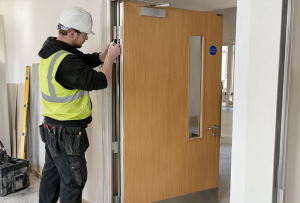
At Fire Door Care, we specialize in the full lifecycle of fire door safety. From initial inspections and identifying hardware failures to the precision installation of fire-rated components, we ensure your property meets all current safety standards.
Our certified team delivers high-quality solutions to enhance fire resistance, prevent smoke spread, and safeguard lives. Whether you need a new fire door, routine inspections, or urgent repairs, we provide reliable and cost-effective services tailored to your needs.
- Safety First: We prioritise protecting lives and properties by ensuring every fire door meets the highest safety standards.
- Uncompromising Quality: Our expert team delivers precision craftsmanship and reliable solutions for long-lasting fire protection.
- Integrity You Can Trust: We are committed to honest, transparent, and dependable service at every step of the process.
- Customer Focused: Your safety is our mission. We tailor every inspection, repair, and installation to your unique needs.
If you would like to find out more about our fire door services, or would like help, advice or a quote please feel free to call us on 0203 488 5923 or send us a message here.