Following the enforcement of the Building Safety Act 2022 and Section 156 amendments to the Regulatory Reform (Fire Safety) Order 2005, the expectations placed on duty holders, Accountable Persons (APs), and Responsible Persons (RPs) across the UK built environment have shifted dramatically.
One of the central tenets of this legislative framework is competence. Fire doors form a critical part of passive fire protection and compartmentation, yet historical fire safety failures have repeatedly highlighted gaps in inspection quality and technical knowledge.
This comprehensive guide breaks down how UK law defines competence for fire door inspections, how duty holders can demonstrate compliance, and what separates simple routine checks from formal technical audits.
How the Building Safety Act 2022 Redefined Fire Safety Responsibilities
Prior to recent legislative updates, fire door maintenance was often managed under broad obligations to keep fire precautions “in working order”. The Building Safety Act 2022 and the Fire Safety (England) Regulations 2022 (FSER) established explicit, recurring obligations and elevated the legal accountability of building managers.
The Building Safety Act 2022 significantly updated UK fire safety legislation by amending Section 156 of the Regulatory Reform (Fire Safety) Order 2005, introducing strict statutory requirements for anyone performing fire risk or safety duties to prove their competence.
For higher-risk buildings, this framework establishes the legal role of the Accountable Person and introduces the “Golden Thread”, a mandatory digital record of a building’s safety information.
Working alongside the Fire Safety (England) Regulations 2022, the law sets clear operational benchmarks for residential buildings over 11 metres, mandating quarterly checks on communal fire doors and annual inspections of individual flat entrance doors.
The Legal Definition: What Competence Means Under UK Fire Safety Law
While UK legislation repeatedly mandates the use of a “competent person,” it deliberately avoids listing specific mandatory job titles or single qualification badges. Instead, competence is legally evaluated on whether an individual possesses sufficient:
- Training tailored to the specific task.
- Knowledge of building codes, timber behaviour, and fire resistance standards.
- Experience in evaluating passive fire systems across relevant building types.
- Skills to accurately identify non-compliant components on site.
Legal Principle: Competence is context-dependent. An individual competent to perform a routine check on a standard FD30 timber door in a low-rise office is not automatically competent to carry out a complex survey on specialized FD60 or FD120 doorsets in a multi-storey healthcare facility or Higher-Risk Building (HRB).
The SKEB Framework: Breaking Down the Core Pillars of Inspector Competence
In line with overarching construction competence standards (such as PAS 8670 and BS 8674:2025), industry guidance evaluates fire door inspector competence through four distinct pillars, commonly referred to as the SKEB framework:
| Pillar | What Is Required | Practical Application in Fire Door Inspections |
| Skills | Practical physical ability | Accurately measuring perimeter gaps (e.g., ≤3mm-4mm rule), testing self-closer forces, inspecting intumescent strips/smoke seals, and inspecting latch alignment. |
| Knowledge | Technical and statutory understanding | Understanding BS 8214 (code of practice for timber fire door assemblies), test reports, field of application documents, third-party certification schemes, and ironmongery compatibility. |
| Experience | Application across real-world settings | Recognizing failure patterns, differentiating between certified, notional, and nominal fire doors, and accurately evaluating older door assemblies. |
| Behaviours | Professionalism and ethics | Exercising sound judgement, producing defensible audit reports, understanding duty-holder responsibilities, and maintaining ongoing Continuing Professional Development (CPD). |
Simple Visual Checks vs. Formal Professional Inspections: Who Is Permitted to Do What?
A common point of confusion for building owners is the difference between routine checks required by FSER 2022 and formal technical inspections under BS 8214. Government guidance clarifies that these tasks carry different competence entry bars:
1. Routine Condition Checks (FSER 2022 / In-House Staff)
- Scope: Basic operational checks confirming the door closes fully into the frame, checking for obvious mechanical damage, and verifying that intumescent seals are present.
- Who Can Perform: Trained facilities managers, caretakers, or building staff who have received basic instruction.
- Frequency: Quarterly for communal doors and annually for flat entrance doors in residential blocks over 11 metres.
2. Formal Technical Inspections (BS 8214 / Professional Surveys)
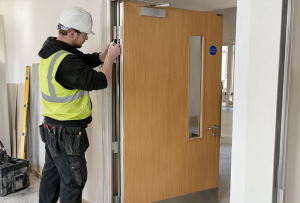
- Scope: Comprehensive survey evaluating gap tolerances across all edges, hinge wear, glass and glazing bead compliance, frame fixings, signage, self-closer holding force, and manufacturer test evidence compliance.
- Who Can Perform: Qualified fire door inspectors holding recognized sector qualifications.
- Frequency: Typically 6-monthly or annually as indicated by the Fire Risk Assessment, or immediately following building works/remediation.
The Role of British Standards and Third-Party Certification (BS 8214 & Beyond)
To establish defensible competence, inspectors rely on national standards and accredited training frameworks.
Key British Standards
- BS 8214: The principal code of practice for timber fire door assemblies, detailing installation, gap tolerances, hardware selection, and maintenance practices.
- BS 9999 / BS 9991: Code of practice for fire safety in the design, management, and use of buildings.
- PAS 8670: Framework for competence of individual safety specialists in the built environment.
Accredited Qualification Routes
While no single statutory license exists, inspectors demonstrate formal competence through qualifications regulated by Ofqual (such as the ABBE Level 3 Award in Fire Door Inspection) or third-party accreditation schemes like LPCB (Loss Prevention Certification Board), FDIS (Fire Door Inspection Scheme), BM TRADA Q-Mark, IFC, or FIRAS.
The Golden Thread: Why Verifiable Record-Keeping Is Essential for Compliance
Under the Building Safety Act 2022, the “Golden Thread” requires an accurate, accessible, and up-to-date digital record of a building’s safety information throughout its lifecycle.
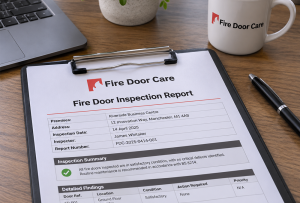
For fire door inspections, a competent inspector must produce reports that integrate seamlessly into this Golden Thread. Inspection reports must clearly record:
- Unique Door Asset ID: Location and reference code for every door leaf and frame assembly.
- Specification & Fire Rating: Whether the assembly is FD30, FD30S, FD60, or FD60S.
- Condition Assessment: Tolerances measured, ironmongery status, seal condition, and self-closer functionality.
- Remediation Actions: Prioritised recommendations for repair or replacement based on risk level.
- Evidence Trail: Inspection date, surveyor credentials, photograph evidence, and sign-off.
Generic or vague inspection logs are no longer sufficient to satisfy enforcement authorities or the Building Safety Regulator.
How Duty Holders Can Verify and Prove Fire Door Inspector Competence
If an enforcement officer or the Building Safety Regulator requests evidence of compliance, the duty holder must prove they exercised due diligence when appointing an inspector.
Verification Checklist for Responsible & Accountable Persons
- Verify Qualifications: Confirm the inspector holds a recognized Level 3 fire door inspection qualification or equivalent third-party registration.
- Check Accreditation Schemes: Look for listings on recognized professional registers..
- Assess Building Familiarity: Ensure the inspector has documented experience with your specific building profile (e.g., residential HRBs, commercial offices, or heritage structures).
- Review Sample Reports: Verify that their inspection reporting methodology aligns with BS 8214 requirements and Golden Thread digital formatting standards.
- Confirm Insurance Coverage: Ensure the inspector/company carries adequate Professional Indemnity (PI) and Public Liability (PL) insurance explicitly covering fire safety surveys.
By following this audit process, duty holders protect building occupants and safeguard themselves against potential prosecution under the UK’s regulatory regime.
Why Choose Fire Door Care?
Fire Door Care are LPCB certified meaning your can have total confidence in our work and your compliance. We specialize in the full lifecycle of fire door safety. From initial inspections and identifying hardware failures to the precision installation of fire-rated components, we ensure your property meets all current safety standards.
Our certified team delivers high-quality solutions to enhance fire resistance, prevent smoke spread, and safeguard lives. Whether you need a new fire door, routine inspections, or urgent repairs, we provide reliable and cost-effective services tailored to your needs.
- Safety First: We prioritise protecting lives and properties by ensuring every fire door meets the highest safety standards.
- Uncompromising Quality: Our expert team delivers precision craftsmanship and reliable solutions for long-lasting fire protection.
- Integrity You Can Trust: We are committed to honest, transparent, and dependable service at every step of the process.
- Customer Focused: Your safety is our mission. We tailor every inspection, repair, and installation to your unique needs.
If you would like to find out more about our fire door services, or would like help, advice or a quote please feel free to call us on 0203 488 5923 or send us a message here.