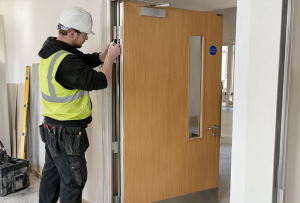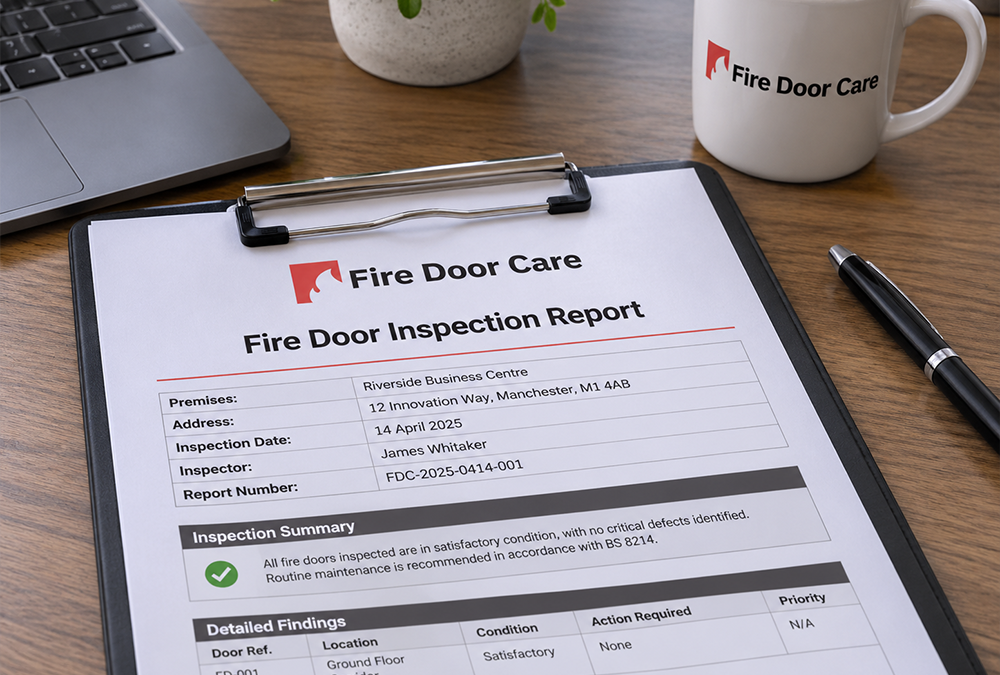
Fire doors are a vital part of any building’s passive fire protection system. Designed to slow the spread of fire and smoke, they help protect escape routes, safeguard occupants and provide valuable time for evacuation.
However, simply installing fire doors is not enough. Over time, regular use, accidental damage, poor maintenance and alterations can compromise their effectiveness. This is why regular fire door inspections are essential.
A professional fire door inspection helps identify defects, assess the condition of existing fire doors and highlight any remedial work required. Just as importantly, the findings should be documented in a comprehensive fire door inspection report.
But what exactly should a fire door inspection report include? How detailed should it be, and what should building owners and responsible persons look for?
In this guide, we explain the essential components of a fire door inspection report, the relevant UK fire safety requirements and why accurate reporting is so important for maintaining fire door compliance.
What Is a Fire Door Inspection Report?
A fire door inspection report is a formal document that records the findings of an inspection carried out on one or more fire door assemblies within a building.
The purpose of the report is to assess the condition of each fire door, identify potential safety issues and provide clear recommendations for repairs, maintenance or replacement where necessary.
A comprehensive report should provide a record of the condition of each inspected door at the time of inspection.
It should also enable the person responsible for the building’s fire safety to understand:
- Which fire doors have been inspected.
- Whether the doors appear to be in satisfactory condition.
- What defects or deficiencies have been identified.
- Which issues require urgent attention.
- What remedial work is recommended.
- Whether further investigation or supporting evidence is required.
- What actions should be taken to maintain fire door performance.
A fire door inspection report is therefore much more than a simple checklist. It provides valuable evidence to support ongoing fire safety management and maintenance.
Importantly, an inspection report should distinguish between visible defects, verified compliance and areas where compliance cannot be confirmed without further documentation or investigation.
Why Are Fire Door Inspection Reports Important?
Fire doors are specifically designed and tested to resist fire and, where required, restrict smoke movement for a defined period.
For example, an FD30 fire door is associated with a nominal 30-minute fire resistance classification when installed as part of a suitable, tested or otherwise appropriately evidenced assembly.
However, the performance of a fire door depends on more than the door leaf itself. The frame, seals, glazing, hinges, closing devices and other components must all work together.
Even relatively minor defects can compromise the performance of a fire door.
A detailed fire door inspection report helps building owners and responsible persons identify these issues before they become more serious.
Supporting Fire Safety Compliance
Fire safety legislation places duties on those responsible for relevant premises to manage fire risks and maintain appropriate fire precautions.
Documented fire door inspections can help demonstrate that reasonable steps are being taken to identify defects and arrange necessary maintenance.
However, an inspection report alone does not establish full legal compliance. Identified defects must also be assessed, prioritised and addressed appropriately.
Identifying Fire Door Defects Early
Fire doors are frequently used in commercial premises, residential buildings, schools, hospitals and other occupied environments.
Daily wear and tear can lead to damaged seals, loose hinges, excessive gaps and faulty door closers.
Regular inspections help identify deterioration so that suitable remedial work can be arranged.
Creating an Accurate Maintenance Record
A fire door inspection report provides a useful reference for future inspections and maintenance.
By maintaining consistent records, building managers can monitor recurring defects, track completed repairs and identify doors that may require replacement.
Helping Prioritise Remedial Work
Not all fire door defects present the same level of risk.
A well-structured inspection report should identify the nature and significance of each defect, helping the responsible person determine which actions need to be prioritised.
What Should a Fire Door Inspection Report Include?
A professional fire door inspection report should be clear, detailed and easy to understand.
Although reporting formats may vary between inspection providers, the following information should normally be included.
1. Building and Inspection Details
Every fire door inspection report should begin with information identifying the premises and the inspection undertaken.
This typically includes:
- Building name and full address.
- Client or organisation commissioning the inspection.
- Date of inspection.
- Name of the inspector.
- Inspection company details.
- Relevant inspector qualifications or competence information.
- Scope and limitations of the inspection.
- Areas of the building included or excluded.
These details establish when, where and by whom the inspection was carried out.
They also help ensure the report can be referenced accurately during future maintenance, fire risk assessments and subsequent inspections.
2. Individual Fire Door Identification and Location
Each fire door should be individually identifiable within the report.
This is particularly important in larger buildings where there may be dozens or hundreds of fire doors across multiple floors.
The report should include:
- A unique door identification number.
- Building, floor or level.
- Room number, corridor or specific location.
- Door type, such as a single or double-leaf assembly.
- Fire resistance classification, where verified.
- Smoke control classification, where applicable and evidenced.
- Any relevant manufacturer or certification information.
For example, a door might be recorded as:
Door ID: FD-025
Location: Second Floor – East Corridor
Door Type: Single-leaf fire door
Recorded Rating: FD30S, subject to verification of supporting evidence
Using unique identification numbers helps building managers locate individual doors and link inspection findings to remedial work orders.
Where possible, door locations should also be cross-referenced against building plans or a fire door asset register.
3. Fire Door Leaf Condition
The fire door leaf is one of the most important components of a fire door assembly.
Inspectors should assess its visible condition and record any damage or alterations that could affect its performance.
Common issues include:
- Cracks, splits or holes in the door leaf.
- Impact damage or deterioration.
- Warping, twisting or distortion.
- Unauthorised modifications.
- Poorly fitted or unsuitable replacement hardware.
- Damaged edges.
- Unprotected or incorrectly repaired cut-outs.
The report should explain the location and extent of any defects.
It should also identify whether further investigation, specialist repair or replacement is recommended.
A damaged fire door leaf should never automatically be assumed suitable for repair. Any proposed remedial work must be compatible with the door’s construction and relevant fire performance evidence.
4. Fire Door Frame and Fixings
The fire door frame plays an essential role in supporting the door and maintaining the integrity of the assembly.
A fire door inspection should assess the visible condition of the frame and its relationship with the surrounding structure.
The report should record any issues involving:
- Cracked, split or damaged frames.
- Loose or unstable frame sections.
- Visible gaps around the frame.
- Inappropriate or deteriorated frame-to-wall sealing.
- Misalignment between the frame and door leaf.
- Missing or damaged frame components.
Inspectors should also consider whether there is evidence that the frame is suitable for the door assembly.
However, concealed frame fixings and fire-stopping arrangements may not be verifiable during a non-intrusive inspection.
Any such limitations should be clearly stated in the report rather than recorded as confirmed compliant.
5. Fire Door Gaps and Clearances
One of the most important elements of a fire door inspection is checking the gaps between the door leaf and frame, as well as the clearance beneath the door.
Excessive or inconsistent gaps can affect a fire door’s ability to resist fire and restrict smoke movement.
The inspection report should record relevant measurements, including:
- Gap at the top of the door.
- Gap along the hinge edge.
- Gap along the closing edge.
- Gap between meeting stiles on double doors.
- Clearance beneath the door.
For many timber-based fire door assemblies, a gap of approximately 2-4 mm around the top and sides is commonly referenced.
However, this should not be treated as a universal requirement.
Acceptable gaps depend on the particular door assembly, its supporting test evidence, manufacturer instructions and any applicable smoke control requirements.
The clearance beneath the door is especially important where smoke control is required.
A professional inspection report should therefore compare the measured clearances against the appropriate specification rather than applying the same tolerance to every door.
6. Intumescent and Smoke Seals
Fire doors often incorporate intumescent seals and, where required, smoke seals.
Intumescent seals expand when exposed to high temperatures, helping to restrict the passage of fire and hot gases through gaps around the door assembly.
Smoke seals are designed to restrict the movement of smoke under relevant conditions.
During an inspection, the inspector should check whether the required seals are:
- Present.
- Correctly positioned.
- Securely fitted.
- Continuous where required.
- Free from visible damage.
- Unpainted or unobstructed where painting or obstruction would impair their function.
- Suitable for the specific door assembly, as far as can be established.
Missing, damaged or incorrectly fitted seals should be documented in the inspection report.
The report should also identify situations where the required seal specification cannot be verified.
7. Hinges and Door Hardware
Hinges, locks, latches and other fire door hardware can directly affect fire door performance.
A fire door inspection report should document the condition and operation of relevant components, including:
- Hinges and their visible fixings.
- Latches and locking mechanisms.
- Door handles.
- Flush bolts and other devices on double doors.
- Letterplates, viewers and other fitted accessories.
- Visible evidence of incompatible or unauthorised hardware.
Inspectors should check for loose, missing or damaged fixings, excessive movement and other operational defects.
Where the fire door specification requires particular hardware or intumescent protection around components, the report should identify whether this can be verified.
It is important that replacement hardware is suitable for the fire door assembly rather than simply being described as fire-rated in isolation.
8. Self-Closing Devices
A fire door can only provide its intended protection when it is closed, unless it is designed and approved to operate in another appropriate configuration.
Many fire doors are therefore fitted with self-closing devices.
A professional inspection should assess whether the door:
- Closes fully from appropriate opening positions.
- Engages with the latch where latching is required.
- Operates without binding against the frame or floor.
- Has a correctly functioning closing device.
- Is free from unauthorised wedges or other obstructions.
- Operates correctly with any approved hold-open or swing-free system.
The report should identify doors that fail to close reliably or remain partially open.
A defective self-closing device can be a significant fire safety concern, particularly where a door protects an escape route or separates areas of differing fire risk.
Not every fire door requires the same closing arrangement. The inspection must take account of the door’s purpose, location and applicable fire safety requirements.
9. Fire-Rated Glazing and Vision Panels
Some fire doors incorporate glazed panels to improve visibility and allow natural light to pass between spaces.
Where glazing is present, it must be suitable for the relevant fire door assembly.
The inspection report should assess visible aspects such as:
- Cracked, chipped or damaged glazing.
- Loose or damaged glazing beads.
- Visible gaps around glazing.
- Missing or damaged glazing seals.
- Evidence of unauthorised glazing alterations.
- Available markings or documentation identifying the glazing specification.
The report should not assume that glazing is compliant solely because it appears intact.
Where the glazing system cannot be identified or its compatibility with the door cannot be confirmed, the report should highlight the need for further verification.
10. Fire Door Signage
Fire door signage helps occupants understand how doors should be used.
Depending on the door’s function and location, signs may indicate that the door must be kept shut, kept locked or operated in a particular way.
The inspection should consider whether appropriate signage is present, legible and correctly positioned.
Any missing, damaged or unsuitable signs should be recorded.
The required signage will depend on the building, the door’s purpose and the relevant fire safety arrangements.
11. Photographic Evidence of Fire Door Defects
Photographs are an extremely valuable part of a professional fire door inspection report.
They provide visual evidence of defects and help those responsible for maintenance understand the work required.
Photographs may document:
- Damaged door leaves.
- Excessive gaps.
- Missing intumescent seals.
- Defective hinges.
- Damaged frames.
- Incorrectly fitted hardware.
- Faulty or missing closing devices.
- Other visible safety concerns.
Ideally, photographs should be clearly labelled with the relevant door identification number and defect description.
Including photographic evidence makes it easier to communicate inspection findings to contractors, facilities managers and other relevant stakeholders.
It can also support comparison during follow-up inspections.
12. Fire Door Defect Classification and Risk Priorities
An effective fire door inspection report should do more than identify defects. It should explain which findings require the most urgent attention.
For example, an inspection provider may use categories such as:
| Classification | Description |
|---|---|
| Critical | A serious defect requiring immediate escalation and appropriate risk controls. |
| High Priority | A significant issue requiring prompt assessment and remedial action. |
| Medium Priority | A defect requiring planned corrective work within an appropriate timeframe. |
| Low Priority | A minor issue requiring monitoring or routine maintenance. |
| No Defect Identified | No visible defect identified within the scope of the inspection. |
These are illustrative categories rather than a universally prescribed UK fire door inspection grading system.
Any grading system used should be explained within the report.
Priorities should take account of the nature of the defect, the door’s location, its fire safety function and the wider building risk assessment.
A report should not imply that a lower-priority defect can be ignored indefinitely.
13. Recommended Fire Door Remedial Works
Identifying defects is only the first stage of effective fire door management.
The inspection report should also provide practical recommendations for addressing them.
Depending on the findings, recommendations might include:
- Adjusting or replacing defective door closers.
- Repairing or replacing damaged seals.
- Addressing unsuitable gaps and clearances.
- Replacing defective hinges or other hardware.
- Investigating damage to frames or door leaves.
- Obtaining missing fire performance documentation.
- Undertaking specialist repairs.
- Replacing fire door assemblies that cannot be suitably repaired.
Recommendations should be specific enough for the responsible person to understand the next steps.
Where repairs are proposed, the report should identify the need to use appropriate components and methods supported by the door assembly’s fire performance evidence.
A competent specialist should assess whether the proposed work is suitable.
14. Overall Inspection Summary
A professional fire door inspection report should include an overall summary of the inspection findings.
This helps building owners and managers understand the general condition of the inspected fire doors without reviewing every individual entry.
The summary may include:
- Total number of doors inspected.
- Number of doors with no visible defects identified.
- Number of doors requiring remedial work.
- Number of doors requiring further investigation.
- Defects grouped by priority.
- Doors that could not be accessed or inspected.
- Common issues identified across the premises.
- Recommended next steps.
For example, an inspection of 100 fire doors might identify 65 with no visible defects, 25 requiring remedial work and 10 requiring further investigation.
These figures would provide a useful overview, but should not be presented as proof that the building is fully compliant.
The report should make clear that inspection findings relate to the doors and conditions assessed at the time of inspection.
15. Inspection Limitations and Supporting Documentation
A particularly important feature of a reliable fire door inspection report is transparency about what has and has not been verified.
Visual inspections cannot always establish the internal construction of a door leaf, the suitability of concealed fixings or the fire resistance performance of an unidentified assembly.
The report should therefore identify:
- Doors that were inaccessible.
- Areas that could not be examined.
- Missing manufacturer information.
- Unverified fire resistance classifications.
- Concealed components that were not inspected.
- Assumptions made during the inspection.
- Any additional testing, documentation or investigation required.
Where available, supporting documentation may include manufacturer installation instructions, fire test evidence, certification records, previous inspection reports and maintenance history.
This information helps distinguish between a door that appears to be in good condition and one whose specified fire performance can be substantiated.
How Often Should Fire Doors Be Inspected?
The appropriate frequency of fire door inspections depends on several factors, including the type of building, frequency of use, condition of the doors and findings of the fire risk assessment.
Fire doors in busy corridors, schools, healthcare settings and high-traffic commercial buildings may experience more wear and tear than doors in areas with limited use.
As a result, they may require more frequent checks and maintenance.
Factors influencing inspection frequency include:
- Building occupancy and use.
- Frequency of door operation.
- Previous inspection findings.
- History of damage or repeated defects.
- Environmental conditions.
- The building’s fire risk assessment.
- Relevant statutory checking requirements.
A six-monthly professional fire door inspection is often used as a practical maintenance benchmark, with more frequent checks where risk, usage or legislation requires them.
However, six-monthly inspection is not a universal statutory requirement for every UK fire door.
The inspection programme should be determined by the responsible person with reference to the building’s risk assessment, relevant standards, manufacturer guidance and applicable legal duties.
What Are the Most Common Defects Found During Fire Door Inspections?
Professional fire door inspections frequently identify recurring issues that can affect the performance of fire door assemblies.
Excessive Gaps Around Fire Doors
Poorly adjusted doors, worn hinges and installation defects can create gaps that exceed the permitted specification. These can affect the ability of the assembly to resist fire or control smoke.
Damaged or Missing Fire Door Seals
Intumescent and smoke seals may become loose, damaged, painted over or removed.
Where seals are required, defects can compromise the intended performance of the assembly.
Faulty Self-Closing Devices
A door that does not close fully may fail to provide the required protection when a fire occurs.
This is particularly concerning where doors protect escape routes.
Loose or Damaged Hinges
Loose fixings, damaged hinges and unsuitable replacement hardware can affect door alignment and operation.
Damaged Door Leaves and Frames
Impact damage, holes, cracks and unauthorised alterations may affect fire resistance.
Inadequate Fire Door Documentation
Some buildings contain older fire doors with limited information about their manufacturer, construction or fire resistance classification.
Where sufficient evidence is unavailable, further investigation may be necessary to establish whether the door is suitable for its intended location.
Identifying these issues through regular inspections allows building managers to take informed action and maintain safe premises.
What Happens After a Fire Door Inspection Report Is Issued?
Receiving the report is not the end of the fire door inspection process. The findings should be reviewed and used to create a clear maintenance and remedial action plan.
Step 1: Review the Inspection Findings
The responsible person should review the report, identify significant defects and consider the findings alongside the building’s fire risk assessment.
Step 2: Prioritise Necessary Remedial Works
Serious defects may require immediate risk management measures while suitable repairs or replacements are arranged.
Other defects should be addressed within timescales appropriate to their significance and the building’s fire safety arrangements.
Step 3: Appoint Competent Fire Door Specialists
Fire door repairs and replacements should be undertaken by people with the appropriate knowledge, skills and experience.
Using unsuitable components or repair methods can compromise the performance of an otherwise effective fire door.
Step 4: Record Completed Repairs
A clear record should be maintained of remedial work undertaken.
This may include the door identification number, work completed, date, contractor details and supporting documentation.
Step 5: Arrange Follow-Up Verification Where Required
Where significant defects have been corrected, a follow-up inspection or suitable verification may be needed to confirm that the remedial work has addressed the identified issues.
The fire door asset register and maintenance records should then be updated.
Who Should Carry Out a Fire Door Inspection?
Fire door inspections should be undertaken by individuals with the appropriate competence for the scope and complexity of the inspection.
A competent fire door inspector should understand the construction and operation of fire door assemblies, common defects, relevant standards and the limitations of visual assessment.
They should also be able to recognise when additional evidence or specialist investigation is required.
When selecting a fire door inspection provider, consider:
- Relevant training, qualifications and practical experience.
- Knowledge of applicable fire door standards and guidance.
- Experience with the types of doors and buildings involved.
- The detail and clarity of their inspection reports.
- Their approach to identifying and prioritising defects.
- Whether they can explain the limitations of their findings.
- Any relevant third-party certification or professional credentials.
Third-party certification can provide useful additional assurance, but the scope and validity of any certification should be checked.
Choosing a suitably competent inspector helps ensure that inspection findings are accurate, meaningful and useful for ongoing fire safety management.
How to Choose a Professional Fire Door Inspection Service
Not all fire door inspection services provide the same level of reporting. When appointing a contractor, it is worth establishing exactly what is included in the inspection and the final report.
A comprehensive service should offer clear door identification, detailed defect records, relevant measurements, photographic evidence and practical recommendations. It should also explain any exclusions, inaccessible doors and aspects of compliance that cannot be verified.
Where the provider also offers fire door repairs, maintenance or replacement services, this may help streamline the process of addressing identified defects. However, inspection findings and recommendations should remain evidence-based and transparent.
The aim should be to give the responsible person an accurate understanding of the condition of their fire doors and the actions needed to maintain them.
Fire Door Inspection Report Frequently Asked Questions
Is a Fire Door Inspection Report a Legal Requirement in the UK?
There is no universal legal requirement for every UK building to hold a document specifically titled a fire door inspection report. However, relevant fire safety legislation requires appropriate fire precautions to be maintained, and certain buildings in England are subject to specific fire door checking duties.
Documented inspections are an important way of demonstrating ongoing monitoring, identifying defects and recording maintenance decisions.
What Should Be Included in a Fire Door Inspection Checklist?
A fire door inspection checklist should cover the door leaf, frame, gaps, seals, hinges, closing devices, latches, glazing, signage and any other relevant components.
It should also record door identification details, visible defects, relevant measurements, inspection limitations and recommended actions.
How Long Should Fire Door Inspection Reports Be Kept?
There is no single statutory retention period that applies to every fire door inspection report across all UK premises. Reports should be retained as part of an appropriate fire safety record-keeping system, taking account of applicable legal requirements, the building’s risk profile and ongoing maintenance needs.
Keeping historical records can help demonstrate how defects have been identified and addressed over time.
Can a Fire Door Fail an Inspection?
Yes. A fire door inspection can identify defects or deficiencies that mean the assembly does not meet the relevant inspection criteria or requires remedial work. However, a report should distinguish between confirmed defects, suspected issues and situations where compliance cannot be verified.
The absence of visible defects does not automatically prove that a fire door assembly achieves a particular fire resistance classification.
Can Fire Door Defects Be Repaired?
Some defects can be addressed through appropriate adjustment, maintenance or specialist repair. However, the suitability of any repair depends on the door assembly, the nature of the defect and the available supporting evidence.
Where an effective and appropriately evidenced repair is not possible, replacement may be necessary.
Do Fire Door Inspection Reports Need Photographs?
Photographs are not universally mandated for every fire door inspection report. However, photographic evidence is strongly recommended because it helps identify defects, communicate findings and support remedial work planning.
What Is the Difference Between an FD30 and an FD60 Fire Door?
FD30 and FD60 are commonly used UK designations associated with nominal fire resistance periods of 30 and 60 minutes respectively. The actual fire performance depends on the tested or appropriately assessed door assembly, including its frame, hardware, seals and installation.
An FD30 or FD60 label alone should not be treated as proof that the installed assembly is compliant.
Book a Professional Fire Door Inspection
A comprehensive fire door inspection report is an essential tool for understanding the condition of your building’s fire doors and identifying the steps required to maintain their effectiveness.
From checking door leaves, frames and seals to assessing closing devices, hardware and clearances, a detailed inspection can highlight defects that might otherwise go unnoticed.
For landlords, property managers, facilities managers and business owners, regular fire door inspections provide valuable information to support fire safety compliance and ongoing building maintenance.
Our professional fire door inspection services help you identify defects, understand remedial requirements and make informed decisions about fire door maintenance.
Whether you manage a commercial property, residential development, school, healthcare facility or another type of premises, our team can help you assess the condition of your fire doors and identify the next steps.
Contact our team today to arrange a professional fire door inspection or request a quotation for your property.
Ensure your fire doors are properly inspected, maintained and ready to perform their intended function when needed.
Why Choose Fire Door Care?
Fire Door Care are LPCB certified meaning your can have total confidence in our work and your compliance. We specialize in the full lifecycle of fire door safety. From initial inspections and identifying hardware failures to the precision installation of fire-rated components, we ensure your property meets all current safety standards.
Our certified team delivers high-quality solutions to enhance fire resistance, prevent smoke spread, and safeguard lives. Whether you need a new fire door, routine inspections, or urgent repairs, we provide reliable and cost-effective services tailored to your needs.
- Safety First: We prioritise protecting lives and properties by ensuring every fire door meets the highest safety standards.
- Uncompromising Quality: Our expert team delivers precision craftsmanship and reliable solutions for long-lasting fire protection.
- Integrity You Can Trust: We are committed to honest, transparent, and dependable service at every step of the process.
- Customer Focused: Your safety is our mission. We tailor every inspection, repair, and installation to your unique needs.
If you would like to find out more about our fire door services, or would like help, advice or a quote please feel free to call us on 0203 488 5923.