Fire doors are an essential part of a commercial building’s passive fire protection system, helping to prevent the spread of fire and smoke while protecting escape routes. However, simply having fire doors installed isn’t enough. They must also be regularly inspected and maintained to ensure they remain safe, functional and compliant with relevant fire safety requirements.
For business owners, landlords, property managers and facilities managers, one of the most common questions is: how much does a commercial fire door inspection cost in the UK?
The answer depends on several factors, including the number of fire doors within your premises, the size and layout of your building, the type of inspection required and the condition of your existing doors.
In this guide, we’ll explore typical commercial fire door inspection prices, explain what influences the overall cost, outline what’s included in a professional inspection and discuss why regular inspections are a worthwhile investment in building safety.
How Much Does a Commercial Fire Door Inspection Cost?
The cost of a commercial fire door inspection in the UK will vary depending on the property and the inspection provider.
As a general budgeting guide, businesses may encounter prices of approximately £10 to £25 per fire door, although some providers charge more, particularly for smaller inspections, specialist buildings or services requiring more extensive reporting.
Larger commercial properties with substantial numbers of fire doors may benefit from reduced per-door rates, while smaller premises may be subject to a minimum call-out or inspection fee.
The following table provides illustrative pricing for different inspection quantities.
| Number of Fire Doors | Indicative Cost Per Door | Estimated Total Cost |
| 10 fire doors | £15–£25 | £150–£250 |
| 25 fire doors | £12–£20 | £300–£500 |
| 50 fire doors | £10–£18 | £500–£900 |
| 100 fire doors | £10–£15 | £1,000–£1,500 |
| 200 fire doors | £8–£15 | £1,600–£3,000 |
These figures are illustrative budgeting estimates rather than fixed industry tariffs or verified market averages. Actual quotations may vary significantly depending on the scope of work, location, minimum charges and reporting requirements. VAT, remedial works and additional services may be charged separately.
It’s also important to establish exactly what is included in the quoted price. A lower inspection fee doesn’t necessarily represent better value if the service excludes detailed reporting, defect identification or the documentation needed to manage ongoing fire door compliance.
For an accurate commercial fire door inspection cost, it’s advisable to obtain a quotation based on the specific requirements of your building.
What Factors Affect the Cost of a Commercial Fire Door Inspection?
Several factors can influence the amount you’ll pay for a professional fire door inspection.
1. The Number of Fire Doors Being Inspected
The number of fire doors is usually one of the biggest factors affecting the overall inspection cost.
A small office with ten fire doors will generally cost less to inspect than a large hospital, hotel or multi-storey commercial building containing several hundred doors.
However, the cost per door may decrease as the number of doors increases.
This is because inspectors can often assess multiple doors during a single visit, reducing the proportion of time spent travelling, setting up equipment and preparing documentation.
For organisations managing multiple buildings, arranging inspections across an entire property portfolio may offer opportunities to improve efficiency and reduce overall costs.
2. The Size and Layout of the Building
The layout and accessibility of your commercial premises can also affect inspection pricing.
For example, inspecting 50 fire doors across a single office floor may be more straightforward than inspecting the same number of doors spread across several buildings or multiple floors.
Factors that can increase inspection time include:
- Large or complex building layouts.
- Multiple floors or separate buildings.
- Restricted access to certain areas.
- High-security environments.
- Occupied rooms requiring coordinated access.
- Doors located in operationally sensitive areas.
Commercial premises such as hospitals, manufacturing facilities and large residential developments may require additional planning to ensure inspections can be completed safely and efficiently.
3. The Type and Complexity of the Fire Doors
Not all fire doors are identical, and some require more detailed assessment than others.
A standard timber fire door may be relatively straightforward to inspect, while specialist doors or complex assemblies may require additional time and expertise.
Examples include:
- FD30 and FD60 fire doors.
- Double-leaf fire door assemblies.
- Glazed fire doors.
- Steel fire doors.
- Acoustic fire doors with fire-resisting properties.
- Doors fitted with access control or electromagnetic hold-open devices.
- Specialist doors in healthcare or industrial environments.
The inspection must consider the relevant specification and evidence for each doorset or assembly rather than assuming that every door has identical requirements.
4. The Condition of the Existing Fire Doors
The condition of your fire doors can affect how long an inspection takes.
Where doors are in good condition, inspectors may be able to complete their assessments relatively efficiently.
However, doors displaying significant damage, missing components, excessive gaps or operational problems may require additional investigation and documentation.
Common defects include damaged seals, loose hinges, defective self-closing devices, damaged frames and doors that fail to latch correctly.
A professional inspector should clearly record identified defects and provide sufficient information to help the responsible person arrange appropriate repairs.
5. The Level of Inspection and Reporting Required
The scope of the inspection can significantly affect the price.
Some providers offer relatively basic visual inspections, while others provide more comprehensive assessments supported by detailed digital reporting.
Depending on the service, a professional fire door inspection report may include:
- Individual door identification numbers.
- Door location and relevant specifications.
- Photographic evidence of defects.
- Inspection findings for each door.
- Details of non-compliant or potentially unsafe components.
- Recommended remedial actions.
- Defect prioritisation based on risk.
- Digital records for ongoing compliance management.
More detailed reporting may increase the initial cost but can provide valuable information for maintenance planning, repair quotations and future inspections.
6. The Location of Your Commercial Property
Geographical location can influence fire door inspection costs.
Businesses in London and other major cities may encounter different labour rates and operating costs compared with businesses in other parts of the UK.
Travel distances, parking arrangements, congestion charges and access restrictions may also influence quotations.
If your organisation manages several properties, working with a provider capable of coordinating inspections across multiple locations may help simplify administration and reduce unnecessary travel costs.
What’s Included in a Professional Commercial Fire Door Inspection?
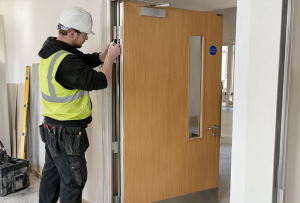
A professional commercial fire door inspection involves more than simply checking whether a door opens and closes.
The purpose is to assess the condition and operation of the fire door assembly and identify defects that could compromise its intended fire-resisting performance.
The precise inspection scope should be agreed with the provider, but it will typically cover the following areas.
Fire Door Leaf and Frame Condition
The inspector will examine the door leaf and frame for visible signs of damage, deterioration, distortion or unauthorised alterations.
This may include checking for cracks, warping, impact damage, missing components and defects that could affect the integrity of the assembly.
Fire Door Gaps and Clearances
The gaps between the door leaf, frame and threshold will be assessed against the relevant manufacturer’s instructions, certification evidence and applicable guidance.
Excessive or inappropriate gaps can compromise the ability of a fire door to restrict the spread of fire and smoke.
Importantly, there is no single gap measurement that applies universally to every fire door. Acceptable clearances depend on the tested or assessed doorset design and its installation requirements.
Hinges, Locks and Latches
The inspector will assess whether hinges, locks, latches and other relevant hardware are present, secure, operational and appropriate for the door assembly.
Loose, damaged or incompatible components may prevent the door from functioning as intended during a fire.
Intumescent Strips and Smoke Seals
Intumescent strips and smoke seals will be examined where they form part of the door’s required specification.
The inspector will look for missing, damaged, incorrectly fitted or deteriorated seals that could compromise fire or smoke resistance.
Self-Closing Devices
Where a fire door requires a self-closing device, the inspector will check whether it operates correctly.
This includes assessing whether the door closes reliably from relevant opening positions and engages with its latch where required.
A fire door that fails to close fully may not provide its intended protection during an emergency.
Glazing and Other Door Components
For glazed fire doors, inspectors will assess glazed panels, vision panels, glazing beads, signage and other fitted components.
They may also check for unauthorised modifications, such as inappropriate holes, altered hardware or incompatible replacement components.
Fire Door Inspection Report
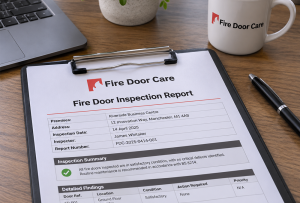
Following the inspection, the provider should supply a fire door inspection report documenting the findings.
A detailed report enables building owners and facilities managers to understand which doors require attention, plan repairs or replacements, and maintain appropriate fire safety records.
It’s worth confirming whether photographic evidence, door-by-door reporting and recommendations for remedial works are included in the inspection price.
Are Commercial Fire Door Inspections a Legal Requirement in the UK?
Fire safety legislation places duties on those responsible for the safety of commercial buildings.
In England and Wales, the Regulatory Reform (Fire Safety) Order 2005 requires the responsible person to take appropriate fire safety precautions and ensure relevant fire safety measures are maintained in an efficient state, in efficient working order and in good repair.
Fire doors form part of these measures where they are provided to protect escape routes, maintain compartmentation or support the building’s fire safety strategy.
Consequently, responsible persons must ensure fire doors are appropriately maintained and that suitable checks and inspections are carried out.
However, there is no universal legal requirement for every commercial fire door in the UK to receive a professional inspection at exactly the same interval.
Inspection arrangements should reflect the applicable legislation, the building’s fire risk assessment, the use and condition of the doors, relevant guidance and any specific requirements applying to the premises.
Fire Door Inspection Requirements in High-Rise Residential Buildings
Additional requirements apply to certain residential buildings in England.
Under Regulation 10 of the Fire Safety (England) Regulations 2022, responsible persons for residential buildings over 11 metres in height must undertake:
- Quarterly checks of fire doors in communal areas, including self-closing devices.
- Annual checks of flat entrance doors, including self-closing devices, on a best-endeavours basis.
These requirements concern specified multi-occupied residential buildings and should not be treated as a universal inspection schedule for all commercial premises.
Other requirements and guidance may apply depending on the building type and UK jurisdiction.
For commercial property owners, a competent fire safety professional can help establish an appropriate inspection programme based on the building’s individual circumstances.
You can learn more about fire doors in high-rise residential buildings in our blog post Understanding Regulation 10: New Fire Safety Duties for High-Rise Residential Buildings.
How Often Should Commercial Fire Doors Be Inspected?
The appropriate inspection frequency will depend on the type of building, the level of use and the risks identified.
For many commercial properties, a formal professional inspection at least annually may provide a useful starting point for maintenance planning. However, annual inspections alone may not be sufficient for every building.
Doors subject to heavy use, frequent damage or demanding operating conditions may require more frequent checks.
For example, fire doors in busy corridors, warehouses, hospitals and educational facilities can experience substantial wear and tear.
You can learn more about fire doors in heavy use areas in our blog post Common Fire Door Damage in High-Traffic Areas and How to Prevent It.
A suitable inspection and maintenance programme may include regular visual checks by trained on-site personnel, periodic detailed inspections by competent specialists, and prompt investigation of reported defects.
The appropriate frequency should be established through the fire risk assessment, relevant guidance, manufacturer instructions and any applicable legal duties.
Is a Fire Door Inspection the Same as a Fire Risk Assessment?
No. Although both contribute to fire safety compliance, a fire door inspection and a fire risk assessment serve different purposes.
A fire risk assessment examines the broader fire hazards and risks within a building, including ignition sources, people at risk, escape arrangements and existing fire safety precautions.
A fire door inspection focuses specifically on the condition, suitability and operation of individual fire doors and their associated components.
| Fire Door Inspection | Fire Risk Assessment |
| Focuses on fire door assemblies | Examines overall building fire risks |
| Checks door condition and operation | Identifies hazards and people at risk |
| Records fire door defects | Evaluates fire safety precautions |
| Recommends door repairs or replacement | Recommends wider fire safety improvements |
| Supports ongoing fire door maintenance | Supports overall fire safety management |
Both activities may be necessary to maintain an effective fire safety strategy.
A fire risk assessment may identify the need for specialist fire door inspections, while inspection findings may inform a review of the building’s fire safety arrangements.
Do Commercial Fire Door Inspection Costs Include Repairs?
In most cases, fire door inspection and repair services are priced separately.
An inspection identifies defects and determines where remedial action may be required. Repairs are then undertaken to address those issues.
For example, an inspection may reveal that several fire doors have defective self-closing devices, damaged seals or excessive gaps.
The inspection report should identify these issues so that appropriate repairs can be arranged.
The cost of remedial work will depend on the nature and extent of the defects, the door specification and whether compatible replacement components are available.
Some problems can be resolved through suitable adjustments or component replacements, while more serious damage may require replacement of the door leaf, frame or complete doorset.
Where repairs are proposed, they should be supported by the relevant manufacturer instructions, certification or assessment evidence. Not every defective fire door can be safely repaired.
Businesses may benefit from choosing a provider that offers inspection, maintenance, repair and replacement services, as this can simplify the process of addressing identified defects.
Is It Cheaper to Repair or Replace a Fire Door Following an Inspection?
Repairing an existing fire door can be more cost-effective than replacing it, provided the proposed repair is appropriate and does not compromise the door’s fire-resisting performance.
Minor defects, such as certain loose components or faulty compatible hardware, may be relatively straightforward to rectify.
However, replacement may be necessary where the door has suffered substantial damage, its performance cannot be adequately established, or a suitable repair cannot be supported by the relevant evidence.
The decision should consider the condition of the entire assembly, the required fire resistance, the availability of approved components and the long-term cost of maintenance.
A competent fire door specialist can assess the findings and recommend whether repair or replacement is the most appropriate solution.
You can learn more about this topic in our blog post Fire Door Replacement vs Repair: Which Is More Cost-Effective?
How Can Businesses Reduce Commercial Fire Door Inspection Costs?
Although inspections are an important investment, there are several ways businesses can manage costs without compromising safety.
Arrange Inspections Across Multiple Buildings
Organisations with multiple commercial premises may be able to arrange inspections together, reducing travel requirements and administrative duplication.
Maintain an Accurate Fire Door Asset Register
An up-to-date fire door asset register helps inspectors identify doors, locate previous inspection records and understand outstanding defects.
This can make inspections more efficient and support ongoing compliance management.
Address Minor Defects Before They Become Major Problems
Regular checks and prompt maintenance can help identify deterioration before it develops into more extensive damage.
For example, addressing a defective closing mechanism promptly may prevent additional damage caused by repeated improper operation.
Schedule Inspections in Advance
Planned inspections allow businesses to coordinate access, minimise disruption and avoid unnecessary last-minute arrangements.
Consider a Planned Maintenance Contract
For buildings with large numbers of fire doors, a planned inspection and maintenance contract may offer practical and financial advantages.
These arrangements can help establish predictable inspection schedules, improve record-keeping and ensure identified defects are followed up.
The most effective approach is to consider the total cost of maintaining safe, functional fire doors rather than focusing exclusively on the lowest inspection price.
Why Is Investing in Professional Fire Door Inspections Worthwhile?
Commercial fire door inspections are not simply an administrative exercise.
Fire doors are designed to play a vital role in containing fire and smoke, helping protect escape routes and supporting the safe evacuation of building occupants.
However, damage, poor maintenance, incorrect installation or incompatible replacement components can compromise their performance.
Regular professional inspections help businesses identify these issues before they are overlooked or allowed to deteriorate.
The benefits include:
- Improved fire safety: Identifying defects that could affect fire and smoke containment.
- Support for legal compliance: Helping responsible persons meet applicable maintenance and fire safety duties.
- Reduced risk of costly repairs: Detecting deterioration early and arranging appropriate remedial action.
- Better maintenance planning: Providing clear information about door condition and outstanding work.
- Improved record-keeping: Creating documented evidence of inspections, findings and follow-up actions.
- Greater confidence: Helping building managers understand the condition of their fire doors.
While professional inspections involve an ongoing cost, they form an important part of responsible building management and can help reduce the risks associated with defective or poorly maintained fire doors.
How to Choose a Commercial Fire Door Inspection Company
When comparing fire door inspection quotations, price shouldn’t be the only consideration.
It’s important to establish whether the provider has the competence, experience and processes required to inspect the types of fire doors installed within your building.
Before appointing an inspection company, consider asking the following questions:
- What qualifications, training and experience do your fire door inspectors have?
- Do you hold relevant third-party certification or accreditation, and what activities does it cover?
- What standards, guidance and manufacturer information inform your inspections?
- Will I receive an individual inspection record for each fire door?
- Does the report include photographs and recommended remedial actions?
- Are travel, reporting, VAT and other charges included in the quotation?
- Can you provide quotations for any necessary repairs or replacements?
- Can you support ongoing fire door inspection and maintenance requirements?
A professional provider should be transparent about its inspection methodology, the scope of its services and the documentation you will receive.
Choosing a competent specialist can help ensure that inspection findings are meaningful, clearly documented and suitable for informing future maintenance decisions.
Fire Door Inspection Costs Frequently Asked Questions
How Much Does It Cost to Inspect One Fire Door in the UK?
As an indicative budgeting allowance, some providers may charge approximately £10 to £25 per door for commercial inspections. However, the price of inspecting a single door may be considerably higher because of minimum attendance fees, travel costs and reporting requirements.
Is There a Minimum Charge for a Fire Door Inspection?
Some inspection companies apply minimum charges, particularly for small properties with only a few fire doors. This helps cover travel, administration, inspection time and reporting. Always confirm minimum fees when requesting a quotation.
How Much Does It Cost to Inspect 100 Fire Doors?
Using an illustrative rate of £10 to £15 per door, inspecting 100 commercial fire doors could cost approximately £1,000 to £1,500 before any additional charges. The actual price will depend on the building layout, door types, access arrangements and inspection scope.
Are Fire Door Inspections Required Every Six Months?
Not universally. There is no single six-monthly inspection requirement applying to every commercial fire door in the UK. Inspection frequency should be determined by applicable legal requirements, risk assessment findings, relevant guidance and the condition and usage of the doors.
How Long Does a Commercial Fire Door Inspection Take?
The time required depends on the number of doors, their condition, accessibility and the detail of the inspection. A small commercial property may be assessed in a relatively short visit, while larger buildings or complex portfolios may require one or more full working days.
Can a Facilities Manager Carry Out Fire Door Checks?
Facilities managers and appropriately trained staff can undertake routine visual checks where they have the necessary competence. However, detailed inspections may require specialist knowledge of fire door assemblies, certification evidence, installation requirements and defect assessment. The responsible person should ensure that anyone undertaking inspections is competent for the work assigned.
What Happens If Fire Doors Fail an Inspection?
The inspection report should identify the defects and recommend appropriate remedial action. Depending on the findings, this may involve repairs, adjustments, replacement components or complete door replacement. Serious defects affecting fire safety may require urgent action and interim risk-control measures.
Can I Get a Quote for Fire Door Inspections and Repairs Together?
Yes. Some fire door specialists provide inspection services alongside maintenance, repairs and replacement. This can simplify contractor management, although the inspection and remedial work should be clearly itemised so you understand the scope and cost of each service.
Get a Quote for Commercial Fire Door Inspections
The cost of a commercial fire door inspection in the UK depends on the number of doors, the complexity of your premises and the level of inspection required.
While indicative per-door prices can help with budgeting, the most reliable way to establish the cost is to obtain a tailored quotation from a competent fire door inspection provider.
Regular inspections help identify defects, support maintenance planning and ensure that fire doors continue to perform their essential role in your building’s fire safety strategy.
Why Choose Fire Door Care?
Fire Door Care are LPCB certified meaning your can have total confidence in our work and your compliance. We specialize in the full lifecycle of fire door safety. From initial inspections and identifying hardware failures to the precision installation of fire-rated components, we ensure your property meets all current safety standards.
Our certified team delivers high-quality solutions to enhance fire resistance, prevent smoke spread, and safeguard lives. Whether you need a new fire door, routine inspections, or urgent repairs, we provide reliable and cost-effective services tailored to your needs.
- Safety First: We prioritise protecting lives and properties by ensuring every fire door meets the highest safety standards.
- Uncompromising Quality: Our expert team delivers precision craftsmanship and reliable solutions for long-lasting fire protection.
- Integrity You Can Trust: We are committed to honest, transparent, and dependable service at every step of the process.
- Customer Focused: Your safety is our mission. We tailor every inspection, repair, and installation to your unique needs.
If you would like to find out more about our fire door services, or would like help, advice or a quote please feel free to call us on 0203 488 5923.